GOLD! love it that someone has done the Footprint of a curry!!
Reposted in full from Warmer Bulletin, 4 June 2010
'Lamb curry ready-made meals eaten in the UK amount to an annual carbon footprint equivalent to 5,500 car trips around the world or 140 million car miles.
The figures were calculated using a new carbon footprinting tool developed by researchers at The University of Manchester.
The estimates are based on the figure of 30 per cent of adults in the UK who eat ready-made meals at least once a week. Curry is one of the nation's favourites, accounting for up to 10 per cent of ready-made sales - which have soared during the recession.
The academics found that the fast food meal generates the equivalent of 4·3 kg of carbon dioxide emissions per person.
The meal's ingredients are responsible for 65 per cent of the carbon footprint, with lamb contributing half of the total. Meal manufacture contributes on average 14 per cent and packaging 4 per cent of the total carbon footprint. The contribution of transport is small at 2 per cent. However, storage at the retailer contributes 16 per cent.
The £1m project is led by Adisa Azapagic, Professor of Sustainable Chemical Engineering at The University of Manchester, and funded by the Carbon Trust, the Engineering & Physical Sciences Research Council and the Natural Environment Research Council.
The previous work by the same research group showed that, surprisingly, the Christmas turkey meal prepared at home is a greener offering, coming in at only 2·5 kg of carbon dioxide emissions per person.
One of the reasons for this, they say, is that preparing food at home can help to reduce the carbon footprint.
"The same lamb curry prepared at home has a 20 per cent lower carbon footprint, mainly because of the elimination of the refrigeration stage at retailer needed for the ready-made meals," said Professor Azapagic.
In addition to food products, the CCaLC carbon footprinting tool can be used for estimation of carbon footprints of other products, including packaging, biofuels and various chemicals.
With respect to application to the chemicals sector, the version of the tool for estimating the carbon footprints of PVC is available for free on the CCaLC website.
The CCaLC tool will be launched in London, where the team will introduce the tool and demonstrate on a number of case studies how it can be used and what benefits can be gained.
The research was carried out as part of the Carbon Calculations over the Life Cycle of Industrial Activities (CCaLC) project at The University of Manchester.
Professor Azapagic said, "Measuring carbon footprints of industrial and other human activities is a first step towards a better understanding of our impacts on climate change. Because, what can be measured, can be managed.
"But the devil is in the detail - measuring carbon footprints is not a trivial task. Industrial and human activities are notoriously complex, so capturing that complexity is a challenge.
"It is particularly so if we expect businesses - and consumers - to make everyday decisions based on the estimations of carbon footprints of their activities.
"And yet this should be the ultimate aim, as only then can we hope to make a real contribution towards mitigating the effects of climate change.
"We have considered all life cycle stages in estimating the carbon emissions - including long-distance transportation for imported food and short distances related to food shopping.
"Food production and processing are responsible for up to three quarters of the total carbon footprint for most food products - so this sector is an important part of our work."'
26 June 2010


Australia's Waste Report
A lot of useful info, facts and figures...
Reposted in full from Warmer Bulletin, 7 May 2010
'Australia's first comprehensive report on waste and resource recovery has been released - the National Waste Report 2010.
The National Waste Report brings together for the first time a wide range of information on waste management and resource recovery. It draws on a range of published sources, commissioned research and information from states and territories. It is a first step towards establishing baseline data and developing a comprehensive account of waste issues which can be used by industry, government and the community to make informed and timely decisions.
As well as presenting national and state and territory waste data, the report discusses the impacts of landfill, recycling, hazardous waste, organic waste and litter, and describes how Australia managed its waste in the past, the current arrangements, and emerging issues and trends. The report also examines the quality of our data on waste and recycling.
The National Waste Report details trends in waste and resource recovery and is the first step in providing baseline data to inform policy.
Key findings from the National Waste Report 2010 are:
To download a copy of the National Waste Report 2010, visit the Environment Protection and Heritage Council (EPHC) website.'
Reposted in full from Warmer Bulletin, 7 May 2010
'Australia's first comprehensive report on waste and resource recovery has been released - the National Waste Report 2010.
The National Waste Report brings together for the first time a wide range of information on waste management and resource recovery. It draws on a range of published sources, commissioned research and information from states and territories. It is a first step towards establishing baseline data and developing a comprehensive account of waste issues which can be used by industry, government and the community to make informed and timely decisions.
As well as presenting national and state and territory waste data, the report discusses the impacts of landfill, recycling, hazardous waste, organic waste and litter, and describes how Australia managed its waste in the past, the current arrangements, and emerging issues and trends. The report also examines the quality of our data on waste and recycling.
The National Waste Report details trends in waste and resource recovery and is the first step in providing baseline data to inform policy.
Key findings from the National Waste Report 2010 are:
- 43,777,000 tonnes of waste were generated in Australia in 2006-07
- Per capita, Australia generated around 2.08 tonnes of waste in 2006-07, of which 1.08 tonnes was recycled
- The recycling and waste sector is valued at between $7 billion and $11.5 billion
- In 2006-07, 22,707,000 tonnes or 52 per cent of Australia's waste was recycled. Of this 42 per cent was from the construction and demolition waste stream, 36 per cent was from the commercial and industrial waste stream and 22 per cent was from the municipal waste stream
- Organic material made up 62 per cent of waste disposed to landfill
- 99 per cent of households undertake recycling
- 80 per cent of employees would like to see more recycling in the workplace.
To download a copy of the National Waste Report 2010, visit the Environment Protection and Heritage Council (EPHC) website.'
BP and the 'Little Eichmanns'
Pulls no punches!
Reposted in full from TruthDig, 17 May 2010
'Cultures that do not recognize that human life and the natural world have a sacred dimension, an intrinsic value beyond monetary value, cannibalize themselves until they die. They ruthlessly exploit the natural world and the members of their society in the name of progress until exhaustion or collapse, blind to the fury of their own self-destruction.
The oil pouring into the Gulf of Mexico, estimated to be perhaps as much as 100,000 barrels a day, is part of our foolish death march. It is one more blow delivered by the corporate state, the trade of life for gold. But this time collapse, when it comes, will not be confined to the geography of a decayed civilization. It will be global.
Those who carry out this global genocide - men like BP's Chief Executive Tony Hayward, who assures us that "The Gulf of Mexico is a very big ocean. The amount of oil and dispersant we are putting into it is tiny in relation to the total water volume'' - are, to steal a line from Ward Churchill, "little Eichmanns." They serve Thanatos, the forces of death, the dark instinct Sigmund Freud identified within human beings that propels us to annihilate all living things, including ourselves.
These deformed individuals lack the capacity for empathy. They are at once banal and dangerous. They possess the peculiar ability to organize vast, destructive bureaucracies and yet remain blind to the ramifications. The death they dispense, whether in the pollutants and carcinogens that have made cancer an epidemic, the dead zone rapidly being created in the Gulf of Mexico, the melting polar ice caps or the deaths last year of 45,000 Americans who could not afford proper medical care, is part of the cold and rational exchange of life for money.
The corporations, and those who run them, consume, pollute, oppress and kill. The little Eichmanns who manage them reside in a parallel universe of staggering wealth, luxury and splendid isolation that rivals that of the closed court of Versailles. The elite, sheltered and enriched, continue to prosper even as the rest of us and the natural world start to die. They are numb. They will drain the last drop of profit from us until there is nothing left. And our business schools and elite universities churn out tens of thousands of these deaf, dumb and blind systems managers who are endowed with sophisticated skills of management and the incapacity for common sense, compassion or remorse. These technocrats mistake the art of manipulation with knowledge.
"The longer one listened to him, the more obvious it became that his inability to speak was closely connected with an inability to think, namely, to think from the standpoint of somebody else," Hannah Arendt wrote of "Eichmann in Jerusalem."
"No communication was possible with him, not because he lied but because he was surrounded by the most reliable of all safeguards against words and the presence of others, and hence against reality as such."
Our ruling class of technocrats, as John Ralston Saul points out, is effectively illiterate. "One of the reasons that he is unable to recognize the necessary relationship between power and morality is that moral traditions are the product of civilization and he has little knowledge of his own civilization," Saul writes of the technocrat. Saul calls these technocrats "hedonists of power," and warns that their "obsession with structures and their inability or unwillingness to link these to the public good make this power an abstract force - a force that works, more often than not, at cross-purposes to the real needs of a painfully real world."
BP, which made $6.1 billion in profits in the first quarter of this year, never obtained permits from the National Oceanic and Atmospheric Administration. The protection of the ecosystem did not matter. But BP is hardly alone. Drilling with utter disregard to the ecosystem is common practice among oil companies, according to a report in The New York Times. Our corporate state has gutted environmental regulation as tenaciously as it has gutted financial regulation and habeas corpus. Corporations make no distinction between our personal impoverishment and the impoverishment of the ecosystem that sustains the human species. And the abuse, of us and the natural world, is as rampant under Barack Obama as it was under George W. Bush. The branded figure who sits in the White House is a puppet, a face used to mask an insidious system under which we as citizens have been disempowered and under which we become, along with the natural world, collateral damage. As Karl Marx understood, unfettered capitalism is a revolutionary force. And this force is consuming us.
Karl Polanyi in his book "The Great Transformation," written in 1944, laid out the devastating consequences - the depressions, wars and totalitarianism - that grow out of a so-called self-regulated free market. He grasped that "fascism, like socialism, was rooted in a market society that refused to function." He warned that a financial system always devolved, without heavy government control, into a Mafia capitalism - and a Mafia political system - which is a good description of our corporate government. Polanyi warned that when nature and human beings are objects whose worth is determined by the market, then human beings and nature are destroyed.
Speculative excesses and growing inequality, he wrote, always dynamite the foundation for a continued prosperity and ensure "the demolition of society."
"In disposing of a man's labor power the system would, incidentally, dispose of the physical, psychological, and moral entity 'man' attached to that tag," Polanyi wrote. "Robbed of the protective covering of cultural institutions, human beings would perish from the effects of social exposure; they would die as victims of acute social dislocation through vice, perversion, crime, and starvation. Nature would be reduced to its elements, neighborhoods and landscapes defiled, rivers polluted, military safety jeopardized, the power to produce food and raw materials destroyed. Finally, the market administration of purchasing power would periodically liquidate business enterprise, for shortages and surfeits of money could prove as disastrous to business as floods and droughts in primitive society. Undoubtedly, labor, land, and money markets are essential to a market economy. But no society could stand the effects of such a system of crude fictions even for the shortest stretch of time unless its human and natural substance as well as its business organizations was protected against the ravages of this satanic mill."
The corporate state is a runaway freight train. It shreds the Kyoto Accords in Copenhagen. It plunders the US Treasury so speculators can continue to gamble with billions in taxpayer subsidies in our perverted system of casino capitalism. It disenfranchises our working class, decimates our manufacturing sector and denies us funds to sustain our infrastructure, our public schools and our social services. It poisons the planet. We are losing, every year across the globe, an area of farmland greater than Scotland to erosion and urban sprawl. There are an estimated 25,000 people who die every day somewhere in the world because of contaminated water. And some 20 million children are mentally impaired each year by malnourishment.
America is dying in the manner in which all imperial projects die. Joseph Tainter, in his book "The Collapse of Complex Societies," argues that the costs of running and defending an empire eventually become so burdensome, and the elite becomes so calcified, that it becomes more efficient to dismantle the imperial superstructures and return to local forms of organization. At that point the great monuments to empire, from the Sumer and Mayan temples to the Roman bath complexes, are abandoned, fall into disuse and are overgrown. But this time around, Tainter warns, because we have nowhere left to migrate and expand, "world civilization will disintegrate as a whole." This time around we will take the planet down with us.
"We in the lucky countries of the West now regard our two-century bubble of freedom and affluence as normal and inevitable; it has even been called the 'end' of history, in both a temporal and teleological sense," writes Ronald Wright in "A Short History of Progress." "Yet this new order is an anomaly: the opposite of what usually happens as civilizations grow. Our age was bankrolled by the seizing of half the planet, extended by taking over most of the remaining half, and has been sustained by spending down new forms of natural capital, especially fossil fuels. In the New World, the West hit the biggest bonanza of all time. And there won't be another like it - not unless we find the civilized Martians of H.G. Wells, complete with the vulnerability to our germs that undid them in his War of the Worlds."
The moral and physical contamination is matched by a cultural contamination. Our political and civil discourse has become gibberish. It is dominated by elaborate spectacles, celebrity gossip, the lies of advertising and scandal. The tawdry and the salacious occupy our time and energy. We do not see the walls falling around us. We invest our intellectual and emotional energy in the inane and the absurd, the empty amusements that preoccupy a degenerate culture, so that when the final collapse arrives we can be herded, uncomprehending and fearful, into the inferno.'
24 June 2010
Table for Two - Promoting Healthier Meals Locally and School Lunch Donations Internationally
Reposted in full from Japan for Sustainability, April 2010

According to TFT, a billion people in developing countries face hunger and malnutrition; another billion in developed countries suffer from lifestyle-related diseases such as obesity caused by unhealthy eating habits. TFT was established in the fall of 2007 with the aim of addressing these imbalances.
TABLE FOR TWO Aims to Simultaneously Address Hunger and Obesity
TFT point-of-purchase (POP) displays in participating cafeterias help increase awareness about the global problem of starvation, and let people know that their 20-yen donation will go towards paying for school meals in developing countries when they purchase a TFT meal.
The name "TABLE FOR TWO" was inspired by the idea of people in developed countries and children in developing countries sharing a meal at a table - a concept that extends beyond space and time. TFT believes that participating in its program evokes in people a sense of unity as global citizens and deeper empathy for others, and that such a notion is inevitably essential for all people living in this global society.
Social Contribution Activities Originating in Japan
TFT was organized under the premise that "Japan should take the initiative in promoting social action that results in world-changing impacts." Michiko Ando, a TFT staff member, explains the reason why it wished to launch a program that originated in Japan, saying, "The majority of social contribution initiatives in the past began in the U.S. and Europe, and then branch offices were established in Japan. We wanted to reverse this trend by launching a unique project in Japan that would spread out to the world."
At the end of 2007, when TFT was established, only 11 companies and organizations participated in the program. The following year, in April 2008, a new medical care system was introduced in Japan requiring companies to institute specific health check-ups for employees between the ages of 40 and 74 years old, and to provide health counseling to those identified as having a metabolic syndrome, indicating a high risk of developing a lifestyle-related disease such as cardiovascular diseases and diabetes.
Because of the new health-check requirement, TFT began to receive many more inquiries from persons in charge of employee benefits looking for easy-to-accomplish health measures. As a result, the number of participating companies and organizations rapidly increased to 98 by the end of 2008, and to 212 by the end of 2009. As of March 2010, 241 groups were participating in the TFT program.
TFT Promotes School Meal Service in Africa 
TFT is currently working on providing meals in cooperation with other organizations at schools in Uganda, Rwanda, and Malawi in East Africa.
In Uganda, for example, TFT provides meals jointly with the United Nations' project Millennium Villages. To support the school meals program in the project's target villages, the money donated to TFT, minus operating expenses, has been sent to the Millennium Promise, a U.S. non-profit organization working as a representative of Millennium Villages, and the other cooperating organizations, every quarter since April 2008. As of February 2010, TFT has been involved in providing more than 2.45 million meals to schoolchildren.
Millennium Villages http://www.millenniumvillages.org/
In Ruhiira, one of the TFT target villages in Uganda, the number of students increased dramatically after the meal support program started, while the incidence of infectious diseases decreased thanks to people following better practices of washing hands and dishes. In Mwandama, Malawi, the number of students increased from 450 at the launch of the meal service to 700 in January 2009, achieving an attendance rate of 70 percent. Of the 50 graduates from the school, 42 students passed the admission test for higher education.
TFT also provides money and training on how to operate the meal service, with the aim of encouraging local residents to continue the service by themselves after it starts working smoothly. For this reason, TFT uses the money from donations not only for buying raw ingredients but also for covering the expense of operating the meal service, such as the payroll for managers who provide training for parents to run the service by themselves, purchases of kitchen tools, and transportation costs.
The meals being provided by donations help fill the stomachs of hungry children. At the same time, the meal service is expected to help improve school attendance rates and academic performance, strengthen children's primary health and protection against disease, and build community by involving schools and parents, thus playing an important role in resolving the problem of poverty.
TFT started by offering its meal program in cafeterias at participating companies and organizations, and is now expanding its activities to get more people involved. In February 2009, for example, a group of university students established the TFT-University Association in order to spread TFT's program to Japanese university cafeterias nationwide.
In order to make supporting TFT easier for those who do not work for any companies or belong to any organizations participating in the program, it is making efforts to make TFT-licensed meals available at restaurant chains and hotels by forming alliances, and it started to sell products with its logo on them through convenience stores and online shopping websites.
According to Ando, products that offer added value in the form of a donation and contribution to society are increasingly attracting the attention of consumers, and data shows that sales of such products are seeing more growth compared to other brands in a similar price range that don't offer such values. TFT often receives testimonials from people in participating companies such as, "I felt really proud about talking to my children about my work for the first time ever since I joined this company," and "I received a message from a customer saying that we are doing a great job." To provide more opportunities for consumers to join, TFT plans further collaborations with various industries such as restaurants, home-meal manufacturers, retailers including supermarkets and convenience stores, and food and beverage manufacturers.
TFT's launched-in-Japan initiative is expanding to the world. Its first branch office was established in New York in 2008, and started operation in 2009. A cafeteria at the Thunderbird School of Global Management in Arizona in the U.S. is the first place to start participating in TFT's program, and the number of inquiries from businesses and other universities is increasing.
TFT's program has the strength of creating a win-win situation between the supporters and the supported, by encouraging better health for children in developing countries and people in developed countries at the same time.
Moreover, it leads to an improved social reputation as well as increased sales for participating companies. Individuals who buy TFT-licensed meals say they are filled with a warm feeling when they think of the happy smiles of children in Africa no longer hungry because of the donated meals. School lunches served in African schools gives students a stronger will to study, a chance for higher education, and finally, the ability to rise out of poverty.

TFT's program brings not only better health to participants, but also helps create a sense of happiness and wellbeing. We hope to see this program from Japan continue to bring such benefits and spread worldwide.'

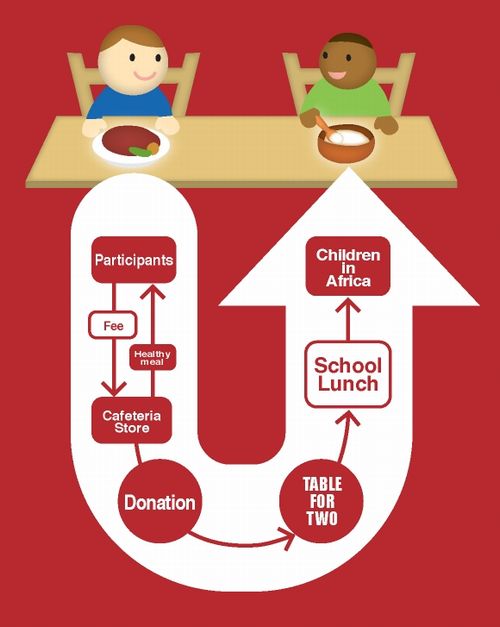
'Have you heard of "TABLE FOR TWO"? It's a unique social contribution program that originated in Japan. In this issue of the JFS Newsletter, we introduce the non-profit organization TABLE FOR TWO International (TFT) and its unique charitable program.
According to TFT, a billion people in developing countries face hunger and malnutrition; another billion in developed countries suffer from lifestyle-related diseases such as obesity caused by unhealthy eating habits. TFT was established in the fall of 2007 with the aim of addressing these imbalances.
TABLE FOR TWO Aims to Simultaneously Address Hunger and Obesity
Under the TFT program, participating companies and organizations offer meals in their cafeterias that have lower calories and more balanced nutritional value than the usual menu items, and they advertise them as TFT meals. Employees who choose one of these items are charged an additional 20 yen as a donation (20 U.S. cents) to support TFT's school lunch programs for children in Africa. The 20-yen donation is equal to the price of one school meal for a child in a developing country; so one meal is donated to a child for every TFT meal eaten in a developed country.
TFT point-of-purchase (POP) displays in participating cafeterias help increase awareness about the global problem of starvation, and let people know that their 20-yen donation will go towards paying for school meals in developing countries when they purchase a TFT meal.
The name "TABLE FOR TWO" was inspired by the idea of people in developed countries and children in developing countries sharing a meal at a table - a concept that extends beyond space and time. TFT believes that participating in its program evokes in people a sense of unity as global citizens and deeper empathy for others, and that such a notion is inevitably essential for all people living in this global society.
Social Contribution Activities Originating in Japan
TFT was organized under the premise that "Japan should take the initiative in promoting social action that results in world-changing impacts." Michiko Ando, a TFT staff member, explains the reason why it wished to launch a program that originated in Japan, saying, "The majority of social contribution initiatives in the past began in the U.S. and Europe, and then branch offices were established in Japan. We wanted to reverse this trend by launching a unique project in Japan that would spread out to the world."
At the end of 2007, when TFT was established, only 11 companies and organizations participated in the program. The following year, in April 2008, a new medical care system was introduced in Japan requiring companies to institute specific health check-ups for employees between the ages of 40 and 74 years old, and to provide health counseling to those identified as having a metabolic syndrome, indicating a high risk of developing a lifestyle-related disease such as cardiovascular diseases and diabetes.
Because of the new health-check requirement, TFT began to receive many more inquiries from persons in charge of employee benefits looking for easy-to-accomplish health measures. As a result, the number of participating companies and organizations rapidly increased to 98 by the end of 2008, and to 212 by the end of 2009. As of March 2010, 241 groups were participating in the TFT program.
The program has a lot of advantages, including the following: it is easy for anyone to participate; it simultaneously promotes social contribution and better health to prevent metabolic syndrome; it has a low initial cost of just 10,000 yen (about $108) for posters and POP displays; it attracts people's attention as a program of Japanese origin; and it is easy to understand that making a 20-yen contribution pays for one school meal. Participants often say, "It's great that we can easily contribute to society in our daily lives. All we need to do is go to the cafeteria and choose a meal from the TFT menu."
TFT Promotes School Meal Service in Africa

TFT is currently working on providing meals in cooperation with other organizations at schools in Uganda, Rwanda, and Malawi in East Africa.
In Uganda, for example, TFT provides meals jointly with the United Nations' project Millennium Villages. To support the school meals program in the project's target villages, the money donated to TFT, minus operating expenses, has been sent to the Millennium Promise, a U.S. non-profit organization working as a representative of Millennium Villages, and the other cooperating organizations, every quarter since April 2008. As of February 2010, TFT has been involved in providing more than 2.45 million meals to schoolchildren.
Millennium Villages http://www.millenniumvillages.org/
Millennium Promise http://www.millenniumpromise.org/
In Ruhiira, one of the TFT target villages in Uganda, the number of students increased dramatically after the meal support program started, while the incidence of infectious diseases decreased thanks to people following better practices of washing hands and dishes. In Mwandama, Malawi, the number of students increased from 450 at the launch of the meal service to 700 in January 2009, achieving an attendance rate of 70 percent. Of the 50 graduates from the school, 42 students passed the admission test for higher education.
TFT also provides money and training on how to operate the meal service, with the aim of encouraging local residents to continue the service by themselves after it starts working smoothly. For this reason, TFT uses the money from donations not only for buying raw ingredients but also for covering the expense of operating the meal service, such as the payroll for managers who provide training for parents to run the service by themselves, purchases of kitchen tools, and transportation costs.
The meals being provided by donations help fill the stomachs of hungry children. At the same time, the meal service is expected to help improve school attendance rates and academic performance, strengthen children's primary health and protection against disease, and build community by involving schools and parents, thus playing an important role in resolving the problem of poverty.
TFT Spreading Farther
TFT started by offering its meal program in cafeterias at participating companies and organizations, and is now expanding its activities to get more people involved. In February 2009, for example, a group of university students established the TFT-University Association in order to spread TFT's program to Japanese university cafeterias nationwide.
In order to make supporting TFT easier for those who do not work for any companies or belong to any organizations participating in the program, it is making efforts to make TFT-licensed meals available at restaurant chains and hotels by forming alliances, and it started to sell products with its logo on them through convenience stores and online shopping websites.
According to Ando, products that offer added value in the form of a donation and contribution to society are increasingly attracting the attention of consumers, and data shows that sales of such products are seeing more growth compared to other brands in a similar price range that don't offer such values. TFT often receives testimonials from people in participating companies such as, "I felt really proud about talking to my children about my work for the first time ever since I joined this company," and "I received a message from a customer saying that we are doing a great job." To provide more opportunities for consumers to join, TFT plans further collaborations with various industries such as restaurants, home-meal manufacturers, retailers including supermarkets and convenience stores, and food and beverage manufacturers.
TFT's launched-in-Japan initiative is expanding to the world. Its first branch office was established in New York in 2008, and started operation in 2009. A cafeteria at the Thunderbird School of Global Management in Arizona in the U.S. is the first place to start participating in TFT's program, and the number of inquiries from businesses and other universities is increasing.
It is expected that its initiative will spread wider in the near future. At the same time, it is considering opening another branch in Italy. Ando expressed their ambitions, saying, "We want to expand our activity to Italy, where the slow food movement was first started."
TFT's program has the strength of creating a win-win situation between the supporters and the supported, by encouraging better health for children in developing countries and people in developed countries at the same time.
Moreover, it leads to an improved social reputation as well as increased sales for participating companies. Individuals who buy TFT-licensed meals say they are filled with a warm feeling when they think of the happy smiles of children in Africa no longer hungry because of the donated meals. School lunches served in African schools gives students a stronger will to study, a chance for higher education, and finally, the ability to rise out of poverty.

TFT's program brings not only better health to participants, but also helps create a sense of happiness and wellbeing. We hope to see this program from Japan continue to bring such benefits and spread worldwide.'
22 June 2010
Collaborative Consumption
Reposted in full from Australian Policy Online, 11 June 2010
'It's a new socio-economic "big idea" promising a revolution in the way we consume. Collaborative Consumption describes the rapid explosion in traditional sharing, bartering, lending, trading, renting, gifting, and swapping redefined through technology and the latest social media and peer-to-peer online platforms.
After several years of researching this phenomena, Rachel Botsman is on a mission to "make sharing cool", convinced we may be witnessing a shift from the Culture of Me to the Culture of We.
From enormous marketplaces such as eBay and Craigslist, to emerging sectors such as social lending (Zopa) and car-sharing (Australia's GoGet), Botsman outlines how Collaborative Consumption is disrupting outdated modes of business and reinventing not just what we consume but how we consume.
New marketplaces such as Swaptree, Zilok, Bartercard, AirBnb, and thredUP are enabling "peer-to-peer" to become the default way people exchange—whether it's unused space, goods, skills, money, or services — and sites like these are appearing everyday, all over the world.'
19 June 2010
Nutty Ideas
Crux had the privilege to meet both Robert Rapier and Hannes Kunz at the Global Footprint Network Forum in Italy...chuckling at their analogy below!
Excerpt from R-Squared Energy Blog, 17 June 2010
'My friend Hannes Kunz told me a story last week that I thought was analogous to our increasing dependence on oil over the past century.
Once a truck carrying a load of nuts crashed into a tree. A family of squirrels living in the tree discovered this new resource and began to live the high life on the nuts they had just found. But as their population grew, so did their demand for nuts.
But that truck crash was a one-time event, and the squirrels were rapidly depleting their nut windfall. How do the squirrels cope when they have eaten all the nuts?
Some would suggest a nut-based biofuel refinery as a solution to their problems, but I am getting ahead of myself...'
01 May 2010
[sleep mode]
Crux is taking a six week hiatus traveling overseas - consequently there will be no new posts during this time.
However, there will be lots of news in the lead up to the winter solstice on 21 June, so watch this space!
However, there will be lots of news in the lead up to the winter solstice on 21 June, so watch this space!
The Global Phones-to-Toilets Ratio
Excerpt from Change.org, 15 April 2010
'Right now, India has more cell phones than toilets. That's the headline buzzing over the wires today, thanks to the latest phones-to-toilets ratio released by the United Nations. It's certainly a dramatic factoid. But it's not just true of India's 1.2 billion-strong population — this lopsided statistic is true around the globe, as well.
'Right now, India has more cell phones than toilets. That's the headline buzzing over the wires today, thanks to the latest phones-to-toilets ratio released by the United Nations. It's certainly a dramatic factoid. But it's not just true of India's 1.2 billion-strong population — this lopsided statistic is true around the globe, as well.
It's a "tragic irony" that India is wealthy enough to provide its people with so many phones, and yet so many "cannot afford the basic necessity and dignity of a toilet," says the director of the UN think tank behind the new report, Zafar Adeel. It's an irony that applies globally, too: this year, the International Telecommunication Union reports, the number of mobile subscriptions is expected to surpass five billion. By contrast, some 2.6 billion people — or nearly 40% of the world population — live in conditions with dismal sanitation. Fully 16% of the world is still forced to defecate in public every day...
But why does the number of cell phones so radically outstrip the number of toilets out there, when the latter are literally necessary to keep populations alive?
Polar Bear Sugar Cubes Melt Away in Your Morning Coffee
Sourced from Inhabitat, 27 April 2010

'These days it’s hard to deny that global warming is melting away our precious glaciers, and, sadly, the animals living in the polar regions are the ones that are suffering most. Using this dire fact as her inspiration, Jovana Bogdanović from Young Serbian Designers sends a clear and provocative message regarding a specific endangered species – the polar bear. Showcased during Milan Design Week, Sugar Bear is a sugar cube in the shape of a polar bear that will slowly melt away in your morning cup of tea or a coffee.'

'These days it’s hard to deny that global warming is melting away our precious glaciers, and, sadly, the animals living in the polar regions are the ones that are suffering most. Using this dire fact as her inspiration, Jovana Bogdanović from Young Serbian Designers sends a clear and provocative message regarding a specific endangered species – the polar bear. Showcased during Milan Design Week, Sugar Bear is a sugar cube in the shape of a polar bear that will slowly melt away in your morning cup of tea or a coffee.'
29 April 2010
Earth's Nine Life Support Systems
Note that the big two are not climate change - but species loss and the nitrogen cycle - both intimately connected with human appropriation of land, for food in particular...


click to enlarge
Excerpt from the New Scientist, 24 February 2010
'Up to now, the Earth has been very kind to us. Most of our achievements in the past 10,000 years - farming, culture, cities, industrialisation and the raising of our numbers from a million or so to almost 7 billion - happened during an unusually benign period when Earth's natural regulatory systems kept everything from the climate to the supply of fresh water inside narrow, comfortable boundaries.
This balmy springtime for humanity is known as the Holocene. But we are now in a new era, the Anthropocene, defined by human domination of the key systems that maintain the conditions of the planet. We have grabbed the controls of spaceship Earth, but in our reckless desire to "boldly go", we may have forgotten the importance of maintaining its life-support systems.
The demands of nearly 7 billion humans are stretching Earth to breaking point. We know about climate change, but what about other threats? To what extent do pollution, acidifying oceans, mass extinctions, dead zones in the sea and other environmental problems really matter? We can't keep stressing these systems indefinitely, but at what point will they bite back?
Last year, Johan Rockström, director of the Stockholm Environment Institute in Sweden, sat down with a team of 28 luminaries from environmental and earth-systems science to answer those questions. The team included Nobel laureate Paul Crutzen, NASA climate scientist James Hansen, Gaia researcher and "tipping point" specialist Tim Lenton, and the German chancellor's chief climate adviser Hans Joachim Schellnhuber.
They identified nine "planetary life-support systems" that are vital for human survival. They then quantified how far we have pushed them already, and estimated how much further we can go without threatening our own survival. Beyond certain boundaries, they warned, we risk causing "irreversible and abrupt environmental change" that could make the Earth a much less hospitable place (Ecology and Society, vol 14, p 32).
The boundaries, Rockström stresses, are "rough, first estimates only, surrounded by large uncertainties and knowledge gaps". They also interact with one another in complex and poorly understood ways. But he says the concept of boundaries is an advance on the usual approach taken by environmentalists, who simply aim to minimise all human impacts on the planet. Instead, he says, boundaries give us some breathing space. They define a "safe space for human development"....
Biodiversity
Boundary: Annual species extinction rate no more than 10 per million per year
Current level: At least 100 per million per year
Diagnosis: Boundary far exceeded
Humans are driving species to extinction by ploughing up or paving over their habitats, by introducing alien species like rats and weeds, by poisoning them with pollution, by hunting them for food and, increasingly, by changing the climate. Individual species may not matter much on their own, but collectively they form ecosystems that provide a range of vital "ecosystem services", such as recycling waste, cleaning water, absorbing carbon and maintaining the chemistry of the oceans.
Although we know that high levels of biodiversity are essential to healthy ecosystems, it is not yet clear how much can be lost before ecosystems collapse, nor which species are the key players in a given ecosystem. So Rockström's team settled on crude extinction rates as the best "interim indicator" of the state of ecosystems. They put the current extinction rate at more than 100 extinctions per million species per year, and rising. That compares with a natural "background" extinction rate of around 0.3. Up to 30 per cent of all mammal, bird and amphibian species will be threatened with extinction this century.
This cannot go on safely. Current rates may even mirror those of the "big five" mass extinctions of the past half-billion years, including the meteorite strike that did for the dinosaurs. While the world carried on after those events, it was massively transformed. To avoid a repeat, they suggest a safe long-term annual extinction rate of no more than 10 per million species per year. By that measure, they say, "humanity has already entered deep into a danger zone... if the current extinction rate is sustained"
Nitrogen
Boundary 1: No more than 35 million tonnes of nitrogen fixed from the atmosphere per year
Current level: 121 million tonnes per year
Diagnosis: Boundary far exceeded and effects worsening...
Nitrogen is an essential component of all living things, yet only a small amount of the planet's stock of nitrogen is in a form that living things can absorb. This is "fixed" out of the air by bacteria in a range of leguminous plants. But you can have too much of a good thing. So other microbes "denitrify" ecosystems, converting the element back into forms not available for living things. This is the nitrogen cycle.
Farmers have always interfered with the cycle, because nitrogen availability often limits the fertility of soils. They have boosted production by planting more leguminous crops, like clover.
Then, a century ago, the nitrogen cycle changed forever when Fritz Haber, a German chemist, invented an industrial process for fixing nitrogen from the atmosphere to make chemical fertiliser. Today, 80 million tonnes of nitrogen is fixed from the atmosphere in this way each year and poured onto the world's fields.
But farming inefficiencies mean that most of this nitrogen runs off the land into rivers and oceans. Much of the nitrogen that does get into crops is later excreted by humans into sewers. We further fix nitrogen by cultivating legumes and burning fossil fuels, timber and crops. Put all that together, and we fix around 121 million tonnes of nitrogen a year, far more than nature does - and nature cannot cope.
The excess nitrogen is acidifying soils, killing vulnerable species and saturating ecosystems so that they lose the ability to recycle the nitrogen back into the air. Meanwhile, some over-fertilised lakes and seas in heavily farmed regions fill with "blooms" of aquatic life which then die and decompose, sucking all the oxygen out of the water in the process. The legacy of such blooms is anoxic "dead zones". At the last count there were more than 400 such zones in the oceans, covering 250,000 square kilometres, including parts of the Gulf of Mexico, the Baltic Sea and waters between Japan and Korea.
Rockström tentatively sets the safe level for human additions to the nitrogen cycle at about 35 million tonnes a year, one-quarter of the current total. Reaching that figure while continuing to feed the world is, to say the least, a tough ask...'
The Shock of the Old: Welcome to the Elderly Age
Reposted in full from the New Scientist, 8 April 2010
'Some worry that an older workforce will be less innovative and adaptable, but there is evidence that companies with a decent proportion of older workers are more productive than those addicted to youth. This is sometimes called the Horndal effect, after a Swedish steel mill where productivity rose by 15 per cent as the workforce got older. Age brings experience and wisdom.
Think what it could mean when the Edisons and Einsteins of the future, the doctors and technicians, the artists and engineers, have 20 or 30 more years to give us.
Of course, many older people do need healthcare, but many others are fit, competent and self-sustaining. Across Europe, typically only one retired person in 20 lives in a care home. In the UK, of 10 million over-65s, just 300,000 live in care homes (that's about 3 per cent). So the majority of Europe's elderly resemble Okushima in Japan. They are the councillors and counsellors, the social secretaries and neighbourhood wardens, the carers of other elderly people, and even the political and social campaigners and agitators - the glue that holds busy societies together. Far from impoverishing societies, says John MacInnes, a demographer at the University of Edinburgh, UK, all the evidence is that "mass longevity facilitates affluence".
The "silver market" is huge. You have only to watch US network television to see the constant advertising aimed at the elderly, from Viagra and holidays to equipment and leisure wear. Oldies have savings and cash from selling large houses they no longer need. The money is available for purchases and investment - and ultimately for their children.
But this is not fundamentally about economics or retirement. It is about society's zeitgeist, its social wellsprings. The cultural historian Theodore Roszak at California State University, East Bay, once took me to task over an article on the threat of ageing societies: "Ageing," he wrote, "is the best thing that has happened in the modern world, a cultural and ethical shift that looks a lot like sanity."
At 50, we do not expect to act or feel as we did at 20 - nor at 80 as we did at 50. The same is true of societies. What will it be like to live in societies that are much older than any we have known? We are going to find out, because the ageing of the human race is one of the surest predictions of this century. If the 20th century was the teenage century, the 21st will be the age of the old: it will be pioneered by the ageing baby boomers who a generation ago took the cult of youth to new heights. Without the soaring population and so many young overachievers, the tribal elders will return. More boring maybe, but wiser, surely.
The older we are, the less likely we are to be hooked on the latest gizmos and the more we should appreciate things that last. We may even reduce pressure on the world's resources by consuming less, and by conserving our environment more. We must especially hope for that, because unless the boomers can pay reparations for youthful indiscretions with the planet's limits then we may all be doomed.
The 20th century did great things. We should be proud that for the first time most children reach adulthood and most adults grow old. But after our exertions, perhaps we need to slow down a bit. Take a breather. Learn to be older, wiser and greener. Doesn't sound so bad, does it? Here's to Ushi Okushima.'
Insulation Nation: Cutting the Cost of Cosy
Excerpt from the New Scientist, 26 March 2010
'Cosy isn't it?" says Amanda James. We are in the kitchen of a modest terraced house in Sheffield, in the north of England, and James is part of a city council team overseeing the regeneration of this down-at-heel neighbourhood. Apart from looking a little smarter than the other houses on the street, there is not much to distinguish it from its neighbours. The difference will only start to show when the heating bills come in: though gas and electricity prices have soared, this is one property that will still be cheap to keep warm.
If everyone lived and worked in such well-insulated spaces, we would be well on the way to a low-carbon world.
The European Union alone uses the equivalent of 6 million barrels of oil a day just to heat its buildings, a figure that could be halved by insulating them properly, according to a 2006 report by Dutch energy consultant Ecofys. The report estimated that this would cut €270 billion a year from the EU's energy bills, and 460 million tonnes from its annual CO2 emissions, meeting its Kyoto commitments at a stroke. It would also create 500,000 jobs.
Until now, most of the effort to make housing more energy efficient has focused on newbuilds. In 2007, the UK government pledged to make all new houses carbon neutral from 2016. In Germany, where regulations are tight already, the pace is being set by even more ambitious standards set out by the PassivHaus Institute in Darmstadt. PassivHaus buildings should use just 10 per cent of energy consumed today by a typical house. Fitted with small-scale solar and wind generators, high-tech homes like these should be able to produce more energy than they consume.
Unfortunately, most people aren't in a position to move to expensive state-of-the-art new homes. Of the UK's 26 million homes, more date from before 1919 than have been built since 1980. At current building rates, 85 per cent of existing housing will still be in use in 2050.
So how much does it cost to achieve a house with a climate-friendly carbon footprint? Not as much as many people may think.
Take the "Banana Farm", the house of energy-efficiency advocate Amory Lovins. In 1983, prompted by the oil shock of the previous decade, Lovins built a radically designed house in Snowmass, Colorado, that used only 10 per cent as much electricity and 1 per cent as much energy for heating as a typical American home of the time. The energy-efficiency elements to achieve that contributed a mere $6000 to the overall $500,000 cost of the house. Energy savings meant that extra investment was recouped in just 10 months.
Last year, Lovins completed a major refit of his property. An energy-management system that uses data collected from 200 monitoring points around the house fine-tunes heating and lighting. A new bank of photovoltaic panels has brought the Banana Farm's peak electricity-generation capacity to 9.7 kilowatts, more than enough to run the sort of low-energy appliances found in a modern home.
Lovins views Banana Farm 2.0 as a laboratory for the future rather than a solution for today's homes. It's the original, low-cost energy savings we should focus on, he says. "Whatever your income, a 10-month payback is about the highest riskless return in the whole economy. Today, the economics would be even better."
Lovins's house was built to be energy-efficient. Old buildings like the Sheffield terrace were not. Tests on the building before work started showed how appallingly draughty it was. Air permeability is measured in cubic metres of air lost per hour per square metre of the house's external area when it is pressurised to 50 pascals. In Germany, building regulations demand an air permeability value no greater than 3.8, and the PassivHaus standard is less than 1. The unimproved Sheffield Eco-terrace scored a carbon-guzzling and uncomfortable 22, but after the refit it scores 6, well within the current UK limit of 10 for newbuild homes.
Although the Eco-terrace refit couldn't run to the expensive gizmos used in Lovins's new house, some clever solutions were still required. Insulating a house that has been built with solid brick walls used to mean fitting thick, foam-backed wallboard to the inside of external walls. In a small house this eats into an unacceptable amount of floor space, so the builders, advised by the industry and government-backed Energy Saving Trust, used a high-performance insulating wallboard made by the UK company Spacetherm.
The insulating layer on the back of the Spacetherm board is made by drying a silica-based gel at high temperature and pressure. This extracts water, leaving a silica matrix that acts as a highly insulating layer. The board used in Sheffield was just 50 millimetres thick; a conventional panel providing equivalent insulation would have had to be 125 millimetres thick.
James argues that homeowners should look on such retrofits as a financial investment like any other, whose return comes from savings in energy costs. To work out what is worth investing in, consumers need accurate figures on the likely payback. With that in mind, the Department of the Built Environment at the University of Nottingham, UK, is running a three-year study into the cost-effectiveness of various energy-saving technologies. Central to the project, which is sponsored by energy company E.On, is a replica of a 1930s semi-detached house that has been built on the Nottingham campus. Three million "semis" like this were built in the UK, and they still form a substantial fraction of the housing stock. "The house provides us with a unique test facility to measure the exact cost-benefit and carbon reduction figures achieved through the various measures," says Mark Gillott, who is leading the research.
"We have the technologies we need," says Catalina Spataru, who is also taking part in the Nottingham project. The question is whether people will use them. Most homeowners can't wait 30 years for their retrofit to pay for itself: people usually move house far more frequently than that, so they have little incentive to invest for the long term.
Finding the right balance of regulation and financial incentive can help solve this problem. In Germany, a combination of cheap finance, tough regulation and market stimulation seems to be doing the trick. German building regulations set energy performance standards for existing buildings as well as new ones: if you want to renovate your house, you have to improve its energy performance. To help homeowners meet those standards, the state-owned development bank KfW offers a programme of grants and cheap loans. The federal government has invested €6.4 billion into the scheme since it started in 2001, with encouraging results. "Since 2006 we have been able to renovate 800,000 homes to a higher energy standard," Wolfgang Tiefensee, the then building minister, said last year.
A pioneering project in Berkeley, California, has shown how the financial benefits can be used to persuade Americans to invest in emissions-saving modifications to their homes. In 2007, Berkeley launched itself as a Sustainable Energy Financing District, lending funds to homeowners wanting to install thermal or photovoltaic panels on their roofs. The loan will be repaid through local taxes over 20 years - though this cost should be more than offset by lower energy bills. A crucial feature of the scheme, known as Property Assessed Clean Energy (PACE), is that the debt stays with the house, so if it changes hands the new owner, who reaps the benefit from its energy-saving features, also pays their fair share of the installation cost.
Following in Berkeley's footsteps, 16 US states have passed legislation that would enable PACE schemes to go ahead, and another dozen are considering it for 2010. "It's extremely promising," says Cliff Staton of clean energy consultants Renewable Funding, who are working on PACE schemes with 200 local bodies and the state of California. He reckons 7 out of 10 Californians will be eligible for the programme by the end of this year.
One criticism of these renewable-energy schemes is that investing in energy efficiency would bring better returns. A PACE scheme being introduced in San Francisco will require homeowners to do just that, Staton says, and use PACE bonds to improve energy efficiency before they are eligible for funding to install solar panels.
A report entitled Unlocking Energy Efficiency in the US Economy, published last year by the consultancy firm McKinsey, calculated that the US could cut its energy demand in 2020 by 23 per cent, saving $1.2 trillion over the next decade in the process, just by improving efficiency. The economic stimulus package introduced by President Barack Obama in February 2009 in the wake of the banking crisis set aside $5 billion to insulate 500,000 of America's poorest homes by the end of 2010.
In the UK, it is local government that has been taking the lead. For example, the borough of Kirklees in West Yorkshire launched a £20 million programme in 2007 called Warm Zone that offers free loft and cavity-wall insulation to every household in the borough. The aim is to retrofit half of the area's 172,000 homes, cutting its total carbon footprint by 2 per cent, or 55,000 tonnes of carbon dioxide per year, which is equivalent to taking 18,000 cars off the road. Around 70,000 homes will have been insulated by the end of 2010, the council says. Kirklees also offers interest-free loans for householders who want to install domestic renewable energy systems.
The national government in the UK is slowly catching up, and this month it announced a scheme of long-term loans for energy retrofits. As with PACE bonds, the debt stays with the house, and loan repayments should be more than offset by reduced energy bills.
Even in developing economies, which use far less energy per head than industrialised nations, there is a growing appetite for using energy more efficiently. China's Development Research Centre estimates energy efficiency measures implemented by state-owned heavy industry could cut China's predicted 2020 power needs by a quarter. The country is also beginning to look at energy use of buildings and has tightened its building codes. There are economic benefits as well as environmental ones: the Asia Business Council calculates that the work needed to save a megawatt of power by making buildings more energy efficient costs less than a quarter as much as installing a megawatt of new generating capacity.
As with most things to do with energy efficiency, it's combining good intentions with economic payback that drives real change. For old houses, the future looks cosy....'
Flooding for Peace
Well, that's that solved, then!
Reposted in full from the New Scientist, 14 April 2010
'Finally, global warming has done its bit for world peace, Feedback hears. Rising sea level in the Bay of Bengal has submerged New Moore Island, resolving a long-standing dispute between India and Bangladesh, which had both claimed it.'
Reposted in full from the New Scientist, 14 April 2010
'Finally, global warming has done its bit for world peace, Feedback hears. Rising sea level in the Bay of Bengal has submerged New Moore Island, resolving a long-standing dispute between India and Bangladesh, which had both claimed it.'
Flushing Forests vs Recycled Content Toilet Paper
Reposted in full from New Scientist, 24 April 2010
'Next time you reach for the toilet roll, consider this: 60 million rolls of toilet paper are flushed away in Europe every day. And the average American gets though 57 sheets a day, six times the global average.
'Next time you reach for the toilet roll, consider this: 60 million rolls of toilet paper are flushed away in Europe every day. And the average American gets though 57 sheets a day, six times the global average.
In a report last week, the Worldwatch Institute in Washington DC highlighted the wastage of paper in rich and rapidly developing nations. In the US, 14.5 million tonnes of office paper and newspaper will be dumped this decade, despite being ideal for recycling as toilet paper.
The potential savings are huge: recycled paper consumes 64 per cent less energy and 50 per cent less water, and creates 74 per cent less air pollution, compared with paper made from virgin wood pulp. The biggest obstacle to recycling, says Worldwatch, is a preference for luxury, multi-ply tissues. The problem is growing: western nations are the biggest users of toilet paper, but its use is increasing in China and Africa.'28 April 2010
Sudden Tipping Points
Cripes! See last sentence!
Reposted in full from the New Scientist, 24 March 2010
'It's not just Iceland's economy that is volatile. The Eyjafjallajökull volcano spewed lava last week - and in the past, such eruptions have set off neighbouring Katla, one of the largest volcanoes on the island.
Reposted in full from the New Scientist, 24 March 2010
'It's not just Iceland's economy that is volatile. The Eyjafjallajökull volcano spewed lava last week - and in the past, such eruptions have set off neighbouring Katla, one of the largest volcanoes on the island.
Katla blew every 40 to 80 years in the thousand years before the last time in 1918. "The eruption is long overdue," says Dave McGarvie of the Open University in Milton Keynes, UK.
"There is quite a bit of anxiety in Iceland about the potential size." Communications links could be cut and transatlantic flights could be disrupted by high-altitude dust.
Katla, beneath the Mýrdalsjökull glacier, has a reputation for triggering jökulhlaup - the sudden release of meltwater from glaciers and ice sheets. Its last eruption generated a peak discharge of 1.6 million cubic metres per second within 4 to 5 hours and moved so much debris that Iceland's coastline was extended by 4 kilometres.'
Solastalgia
From The Word Spy, 28 April 2010
n. Distress or melancholy caused by a significant change to one's local environment.
'Whereas nostalgia is homesickness for a place, solastalgia is a yearning for the way a loved place used to be.'
—Des Houghton, "Pain has a brand new label," The Courier Mail, February 27, 2010
'Ecological degradation is not only affecting our external landscape; it's also influencing our psychic one. Neologisms paint the picture: solastalgia is the depression caused when your local surroundings are damaged significantly; eco anxiety is a generalized worry about the environment.
—Elizabeth Evitts Dickinson, "Eco anxiety," The New York Times, April 20, 2008'
Super Size Jesus
Ha!
Reposted in full from the New Scientist, 24 March 2010
'Over the past 1000 years, Christ and his disciples have been enjoying an ever bigger Last Supper, an analysis of 52 paintings has shown.
Portion size, plate size and bread size have grown respectively by 69, 66 and 23 per cent (International Journal of Obesity, DOI: 10.1038/ijo.2010.37).'
The Climate Flip Side of Shipping Pollution Reduction
Interesting comment from reader on this article:
'SO2 regulated because it harms temperate notherners.
CO2 not regulated because it harms tropical southerners.'
Excerpt from the New Scientist, 17 March 2010
'Environmental paradoxes don't come much bigger. In July this year, the world's shipping lines will begin to apply pollution-cutting rules that will save tens of thousands of lives a year. Yet these very measures - which will radically cut sulphur emissions from ships - have a downside: they will also increase global warming.
When it meets next week, the Marine Environment Protection Committee of the International Maritime Organization (IMO), the UN body that regulates world shipping, will not even be discussing setting limits on regulating the carbon emissions of shipping. Yet it will confirm plans to slash the permitted sulphur content of fuel oil burned by most of the world's ships. Sulphur dioxide (SO2) emissions will diminish by as much as 90 per cent, and with them the resulting haze of sulphate particles.
That's where the problem lies. By shading the planet, the haze partially masks the warming effects of greenhouse gases such as carbon dioxide also produced by the world's fleet of 100,000 ships. Almost a billion tonnes of CO2 are emitted annually by shipping, some 3 per cent of the global total, and it was originally planned that measures to reduce these emissions would also be introduced at next week's meeting.
Those plans are now on hold. As a result, the world is set to suffer a double warming effect from shipping, says Jan Fuglestvedt of the Centre for International Climate and Environmental Research in Oslo, Norway: "one from CO2 and one from the reduction of SO2" (Environmental Science & Technology, vol 43, p 9057).'
Nature's GPS
Book review reposted in full from the New Scientist, 17 March 2010
'Another week, another news story about a driver led astray by their car's satellite navigation system. What is remarkable about these stories is not that satnavs make mistakes, but that the drivers ignored what their eyes and ears were telling them and blindly followed the advice of an automated voice, even as it guided them into a field or to the edge of a cliff.
As we become ever more reliant on GPS systems, the art of navigation is being lost. Tristan Gooley wants to do something about it. The Natural Navigator is full of advice on how to read nature's signposts: the sun, moon, stars and land.
Gooley has flown and sailed, solo, across the Atlantic; in fact, he is to date the only person to have done both. But The Natural Navigator is not just for daring explorers. Even if most of us are unlikely to have to navigate a wilderness, learning to read nature can enhance a walk in a city park or a stroll along the beachfront. Read this and you will never look at the sky or a tree the same way again.'
Game Theory - Self Interest vs Collective Interest
This stuff can get pretty complicated, but in a nutshell, here is what its about - highly relevant to resolving the sustainability challenge:
Excerpt from the New Scientist, 17 March 2010
'The classic example of a problem in game theory is the prisoner's dilemma. It was formulated in 1950 to illustrate a situation where cooperation is the best policy overall but is trumped by raw self-interest, leading to a less-than-ideal outcome for everybody. It goes something like this.
You and your partner in crime have been arrested and placed in separate cells. You are each offered the following deal by the prosecutor: confess, or remain silent.
If you confess and your partner remains silent, all charges will be dropped against you and your partner will go to prison for 10 years.
If you remain silent and your partner confesses, he will go free and you will go down for 10 years.
If you both confess, you will both be sent to prison for 5 years.
If both of you stay silent the prosecutor will rustle up some lesser charge and you'll each do 6 months.
Neither you nor your partner will learn what choice the other has made until after you have both announced your decision.
The dilemma is that, whatever your partner does, you're better off confessing. So the rational choice is to confess. But when you both confess, the outcome is far worse than if you had both remained silent.'
Subscribe to:
Posts (Atom)