07 November 2010

An Urban Orchard

Shot in and around Adelaide, South Australia

www.youtube.com/watch?v=P2oNXksw4Jk


The first South Australian homegrown and gleaned produce swap was held on Saturday 3 November 2008, at the Clarence Park Community Centre. The Urban Orchard is a homegrown fruit and vegetable exchange, enjoying a brisk trade and much discussion over the morning.

The Urban Orchard is based on the exchange of backyard fruit and vegetable surplus. Participation is open to everyone, and participants are invited to take produce when they can use it, and contribute when they can.

The Urban Orchard is an initiative of Friends of the Earth Adelaide and the Goodwood Goodfood Co-op.

When: 10.00am-12noon, first Saturday of the month.

Location: Clarence Park Community Centre, 72-74 East Avenue, Black Forest

Contact: Joel 0403 886 951, joel.catchlove [at] foe.org.au

There are also swap meets at Henley, Croydon and Gawler in South Australia: www.ceres.org.au/node/114

Social Procurement Guide

Reposted in full from Pro Bono News, 14 October 2010

'The Victorian Government has launched a guide to social procurement in Local Government - as part of a national project to develop social procurement procedures for organisations and individuals.

Social Procurement: A Guide for Victorian Local Government

The Centre for Social Impact (UNSW) together with Social Traders, Foresters Community Finance, the Victorian Government, Parramatta City Council and Brisbane City Council are all funding a national research project into social procurement which is due for release later this year.

Social procurement is the process of an organisation choosing to purchase a service which will also provide a social outcome.

The Victorian Government guide was launched by the Minister for Local Government, Richard Wynne and has been developed to support Victorian councils deliver stronger social outcomes through procurement. It is closely aligned with Social Procurement in Australia, an overarching national paper commissioned by the Centre for Social Impact.

The Guide says that each year Victorian councils spend around $3 billion procuring goods and services in a wide variety of expenditure areas. Social procurement recognises the collective buying power of Victoria’s 79 councils and encourages councils to consider what could be achieved if even a small percentage of council spending was focused on ‘value adding’, so that the purchase of goods and services also had positive social outcomes.

For example, it says waste management need not solely be centred around a contract to collect bins and manage waste. It could also simultaneously generate local employment, increase community recycling options, educate the community about waste minimisation, reduce landfill and contribute to building the local economy. The act of strategic procurement can lead to multiple positive social outcomes for the municipality.

Minister Wynne says social procurement is becoming increasingly popular as governments look at ways to meet social objectives as part of their triple-bottom line reporting.

He says the guide is complemented by the Expert Support Program, which will bring the guide to life by supporting the development of social procurement projects and initiatives by councils.

The Expert Support Program: Social Procurement in Practice encourages partnerships between councils and organisations that can deliver social impacts to the community and scope for local business to engage with their local council.

The guide highlights that incorporating social benefits into a council's procurement framework can involve requesting that suppliers deliver social impacts as part of a contract with scope for Not for Profits to actively participate in the tendering process.

While primarily written as a guide for Victorian councils, the guide also provides Not for Profits with insight into how councils are undertaking social procurement and how they might best position their company to engage with councils in this space.

The guide itself is an example of social procurement, having been designed by Blue SKYS Media, a social enterprise of St Kilda Youth Services which offers training and employment opportunities to disadvantaged youth.'

A Ghost Agreement

I love it when George Monbiot gets stuck in...

'It strikes me that governments are determined to protect not the marvels of our world, but the world-eating system to which they are being sacrificed; not life, but the ephemeral junk with which it is being replaced...if governments had met in Japan to try to save the banks, or the airline companies, or the plastic injection moulding industry, they would have sent more senior representatives, their task would have seemed more urgent, and every dot and comma of their agreement would have been checked by hungry journalists. When they meet to consider the gradual collapse of the natural world, they send their office cleaners and defer the hard choices for another ten years, while the media doesn’t even notice that they have failed to produce a written agreement. So, much as I’m revolted by the way in which nature is being squeezed into a column of figures in an accountant’s ledger, I am forced to agree that it may be necessary. What else will induce the blinkered, frightened people who hold power today to take the issue seriously?'

Reposted in full from The Guardian, 2 November 2010

'“Countries join forces to save life on Earth”, the front page of the Independent told us.

“Historic”, “a landmark”, a “much-needed morale booster”, the other papers chorused(1,2,3).

The declaration agreed at the summit in Japan last week to protect the world’s wild species and wild places was proclaimed by almost everyone a great success. There’s only one problem: none of the journalists who made these claims has seen it.

I checked with as many of them as I could reach by phone: all they had read was a press release, which, though three pages long, is almost content-free(4). The reporters can’t be blamed for this: though it was approved on Friday, the declaration has still not been published. I’ve now pursued people on three continents to try to obtain it, without success. Having secured the headlines it wanted, the entire senior staff of the Convention on Biological Diversity has gone to ground: my calls and emails remain unanswered(5). The British government, which lavishly praised the declaration, tells me it has no written copies(6). I’ve never seen this situation before: every other international agreement I’ve followed was published as soon as it was approved.

The evidence suggests that we’ve been conned. The draft agreement, published a month ago, contained no binding obligations(7). Nothing I’ve heard from Japan suggests that this has changed. The draft saw the targets for 2020 that governments were asked to adopt as nothing more than “aspirations for achievement at the global level” and a “flexible framework”, within which countries can do as they wish. No government, if the draft has been approved, is obliged to change its policies.

In 2002, the signatories to the convention agreed something similar: a splendid-sounding declaration which imposed no legal commitments. They announced that they would “achieve by 2010 a significant reduction of the current rate of biodiversity loss”. Mission accomplished, the press proclaimed, and everyone went home to congratulate themselves. Earlier this year, the UN admitted that the 2002 agreement was fruitless: “the pressures on biodiversity remain constant or increase in intensity”(8).

Even the desperately cheery press release suggests that all was not well. The meeting in Japan was supposed to be a summit; bringing together heads of government or heads of state. It mustered five of them: the release boasts of coralling the President of Gabon, the President of Guinea-Bissau, the Prime Minister of Yemen and Prince Albert of Monaco. (It fails to identify the fifth country: Lichtenstein? Pimlico?) One third of the countries represented there couldn’t even be bothered to send a minister. This is how much they value the world’s living systems.

It strikes me that governments are determined to protect not the marvels of our world, but the world-eating system to which they are being sacrificed; not life, but the ephemeral junk with which it is being replaced. They fight viciously and at the highest level for the right to turn rainforests into pulp, or marine ecosystems into fishmeal. Then they send a middle-ranking civil servant to approve a meaningless (and so far unwritten) promise to protect the natural world.

Japan was praised for its slick management of the meeting, but still insists on completing its mission to turn the last bluefin tuna into fancy fast food. Russia signed a new agreement in September to protect its tigers (the world’s largest remaining population)(9), but an unrepealed law effectively renders poachers immune from prosecution, even when caught with a gun and a dead tiger(10). The US, despite proclaiming a new commitment to multilateralism, refuses to ratify the Convention on Biological Diversity.

It suits governments to let us trash the planet. It’s not just that big business gains more than it loses from converting natural wealth into money. A continued expansion into the biosphere permits states to avoid addressing issues of distribution and social justice: the promise of perpetual growth dulls our anger about widening inequality. By trampling over nature we avoid treading on the toes of the powerful.

A massive accounting exercise, whose results were presented at the meeting in Japan, has sought to change this calculation. The Economics of Ecosystems and Biodiversity (TEEB) attempts to price the ecosystems we are destroying(11). It shows that the economic benefit of protecting habitats and species often greatly outweighs the money to be made by trashing them. A study in Thailand, for example, suggests that turning a hectare of mangrove forest into shrimp farms makes $1,220 per year, but inflicts $12,400 of damage every year on local livelihoods, fisheries and coastal protection. The catchment protected by one nature reserve in New Zealand saves local people NZ$136m a year in water bills. Three-quarters of the US haddock catch now comes from within 5km of a marine reserve off the New England coast: by protecting the ecosystem, the reserve has boosted the value of the fishery(12).

I understand why this approach is felt to be necessary. I understand that if something can’t be measured, governments and businesses don’t value it. I accept TEEB’s reasoning that the rural poor, many of whom survive exclusively on what the ecosystem has to offer, are treated harshly by an economic system which doesn’t recognise its value. Even so, this exercise disturbs me.

As soon as something is measurable it becomes negotiable. Subject the natural world to cost-benefit analysis and accountants and statisticians will decide which parts of it we can do without. All that now needs to be done to demonstrate that an ecosystem can be junked is to show that the money to be made from trashing it exceeds the money to be made from preserving it. That, in the weird world of environmental economics, isn’t hard: ask the right statistician and he’ll give you whichever number you want.

This approach reduces the biosphere to a subsidiary of the economy. In reality it’s the other way round: the economy, like all other human affairs, hangs from the world’s living systems. You can see this diminution in the language the TEEB reports use: they talk of “natural capital stock”, of “underperforming natural assets” and “ecosystem services”. Nature is turned into a business plan, and we are reduced to its customers. The market now owns the world.

But I also recognise this: that if governments had met in Japan to try to save the banks, or the airline companies, or the plastic injection moulding industry, they would have sent more senior representatives, their task would have seemed more urgent, and every dot and comma of their agreement would have been checked by hungry journalists. When they meet to consider the gradual collapse of the natural world, they send their office cleaners and defer the hard choices for another ten years, while the media doesn’t even notice that they have failed to produce a written agreement. So, much as I’m revolted by the way in which nature is being squeezed into a column of figures in an accountant’s ledger, I am forced to agree that it may be necessary. What else will induce the blinkered, frightened people who hold power today to take the issue seriously?'

Criminal Probe into E-Waste Exports

Reposted in full from The Environment Agency, 15 October 2010

'The Environment Agency has today charged nine people as part of the biggest investigation into illegal electrical waste exports from the UK to West Africa.

All nine have been charged with offences under the Transfrontier Shipment of Waste Regulations 2007 and European Waste Shipment Regulations 2006 and bailed to attend Havering Magistrates Court on 11 November.

The law is clear that broken electricals, including everyday items such as mobiles, smart phones, laptops and TVs, cannot be sent overseas for disposal. As well as precious metals such as gold, copper and aluminium, electrical waste can contain hazardous substances including mercury and lead that are harmful to people and the environment.

There is good evidence that illegal exports of electrical waste from the UK is ending up on waste sites in Africa, causing harm to those who come into contact with it.

The Environment Agency’s National Environmental Crime Team Manager, Andy Higham, said:

“Over the past two years painstaking intelligence work by Environment Agency officers has uncovered a web of individuals and companies that appear to be making considerable sums of money by exporting electrical waste overseas.

“Exporters of broken electricals put at risk the lives of those who work on waste sites in developing countries. These are often children who are paid a pittance to dismantle products containing hazardous waste. Illegal exporters also avoid the costs of recycling in the UK and undermine law-abiding business.

“It is always a crime to export broken electricals and hazardous waste from the UK to developing countries to be dumped. The last thing we want is our waste causing harm to people or the environment overseas.”

Officers from the Environment Agency’s National Crime Team began their investigations in mid-2008. They soon uncovered a network of individuals, waste companies and export businesses allegedly involved in the export of electrical waste.

In some instances, it is alleged that considerable sums of money changed hands in deals to collect and recycle electrical waste while treatment costs were avoided.'

How Much Would You Pay for Planet Earth?

Excerpt from the New Scientist, 13 October 2010

'Putting a cash value on nature may give officials heading to a biodiversity summit the jolt they need

Invest in lush tropical forests, vibrant coral reefs and clear blue streams, and they will provide a healthy return. That's the message from a group of environmental economists who for the first time have estimated the cash value of ecosystems.

They say the figures show the case for conservation is overwhelming in pure economic terms. One case study found that protecting and replanting mangrove swamps in Vietnam cost $1.1 million - an investment which reduced spending on dyke maintenance by seven times as much each year.

Yet the scientists behind The Economics of Ecosystems and Biodiversity study (TEEB) admit frustration that most mainstream economists are blind to the value of biodiversity.

"Conservation has to be seen as an investment and not a cost," says Rudolf de Groot of Wageningen University in the Netherlands, one of the lead authors of the study.

TEEB was initiated at the 2007 G8 summit, in Germany. "It aims to do for biodiversity what the Stern report did for the economics of climate change," says de Groot. The group will launch the first part of its work - a report called The Economics of Ecosystems and Biodiversity: Ecological and Economic Foundations - at a UN summit on biodiversity in Nagoya, Japan, this month.

In it, they use prior studies to calculate cash values for biomes ranging from tropical rainforests to Arctic tundra, based on the services they provide to humanity.

Coral reefs come in top, and are valued at up to $1.2 million per hectare per year, mostly reflecting the tourism income they provide. By moderating extreme events like storms, the group estimates each hectare of reef saves $34,000 per year, on average. But even humble savannah grasslands, which protect water supplies and store carbon, have a calculated annual worth of thousands of dollars per hectare. Each hectare of coastal wetlands, meanwhile, treats dirty water to the tune of $120,000 in avoided costs each year.

The report makes clear that the value of many "ecosystem services" remains difficult to price, however. Its authors speculate that many woodlands have a high value for filtering air pollution, grasslands for pollination and rainforests for climate regulation. One appendix speculates that, at current prices on carbon offset markets, the carbon tied up in trees and soils of the Amazon rainforest would have a "stock value" of $1.5 to $3 trillion. Many ecosystems also recycle moisture to maintain the water cycle, create soil and perform many other functions vital to life on Earth - something which no ecological economist has yet managed to value.

"For all the ecosystems we investigated, restoration pays," says de Groot. "For every dollar invested in restoration of forests, wetlands or grasslands, the benefits are between twice and 75 times higher." Nonetheless, he says, "getting this understanding incorporated into mainstream economics remains a problem"...

The economists decided not to calculate a single global figure for the planet's ecosystems. But a rough calculation by New Scientist based on TEEB's figures for individual biomes puts the cash value of the Earth's ecosystems at about half a trillion dollars.

This seems far too low, considering that the global economy - much of which is ultimately dependent on biological resources - is valued at around $70 trillion. And lower still, given that by cycling carbon the biosphere acts as a planetary thermostat.

The numbers are therefore most useful as an indicator of the most immediate economic benefits. Including unquantified ecosystem services would considerably raise the figure. After all, as Tim Killeen of Conservation International puts it: "Biodiversity has been the foundation for the world's economy since the origin of human civilisation."

Placing a value on earth's biomes

Value in dollars per hectare per year. THE top end of each value range corresponds to Prime locations Source: TEEB

Coral reefs (tropical and subtropical)
$14 - $1,195,000
Key values: tourism, storm protection, fish nurseries

Coastal wetlands
$2000 - $215,000
Key values: waste purification, fish nurseries, storm protection

Other coastal systems
$248 - $80,000
Key values: tourism, fish nurseries

Inland wetlands
$1000 - $45,000
Key values: natural water reservoirs, waste treatment

Rivers and lakes
$1800 - $13,000
Key values: water supply, waste treatment, tourism

Tropical forests
$91 - $23,000
Key values: climate regulation, gene banks (for medicinal plants, for example), erosion prevention

Temperate and boreal forests
$30 - $4900
Key values: Food, gene banks, watershed protection

Woodlands
$16 - $2000
Key values: timber and other forest products, waste treatment

Grasslands
$300 - $3100
Key values: climate regulation, watershed protection

Promises, promises

In Nagoya, Japan, this month, the world's governments will agree that they have not kept a promise they made at the World Summit for Sustainable Development at Johannesburg in 2002 to decrease the rate of species loss by 2010.

They are likely to agree a new set of targets for 2020, including stemming the loss of biodiversity, controlling invasive species and conserving at least 10 per cent of all the world's major biomes.

Diversitas, a group of leading conservation biologists, has already condemned the proposed new targets as vague, unachievable and not based on good science. Georgina Mace of Imperial College London, a leading figure in Diversitas, told New Scientist: "I don't think the current process or the 2020 targets are really fit for purpose."

In a letter to Nature earlier this year, Mace, Harold Mooney of Stanford University in California and others from Diversitas said: "The targets continue to mix the biodiversity we value highly and the biodiversity we urgently need to secure the benefits people derive from functioning ecosystems. To resolve competing demands, these different priorities should be made explicit."

Diversitas proposes distinguishing three conservation aims. Red targets would protect human safety and include conserving mangroves to shield coastlines against storms, maintaining coral reefs to prevent the loss of local fisheries, and preventing deforestation that causes landslides. Green targets would protect things that societies value - sacred forests or charismatic species like the great whales. Finally, blue targets would protect key ecosystem services, like carbon sinks in forests, soils and permafrost that help maintain the climate.'

Make Presentations Work With Storytelling, Not Facts


'...How do you create a great presentation?...The answers I found had nothing to do with technology or the internet; they were revealed in screenwriting, Greek and Shakespearean drama, mythology and literature.

Great presenters employ the basic narrative techniques used throughout history to connect with audiences and move them to action and new understanding.

The presentations that work are not the ones with the most data or the most elaborate charts and graphs; the winners are those with the most compelling and convincing narratives...'


Excerpt from
CNN, 15 October 2010
  • Army officer fired after publishing essay complaining about useless PowerPoints
  • Nancy Duarte says bad presentations obscure or conceal key points
  • She says successful presentations don't win because of a wealth of data
  • Duarte: What makes a PowerPoint work is great storytelling

'Editor's note: Nancy Duarte is the author of "Resonate: Present Visual Stories that Transform Audiences." She is CEO of Duarte Design, a presentation design firm based in Mountain View, California, that worked with Al Gore on the presentation featured in "An Inconvenient Truth" and whose clients include Cisco, Facebook, Google, TED and the World Bank.

A few weeks ago Col. Lawrence Sellin, a Special Forces officer stationed in Afghanistan, fell victim to a particularly modern hazard of war: PowerPoint fatigue.

Col. Sellin was fired from his post at NATO's International Security Assistance Force after he wrote an essay for the UPI wire service in which he voiced his frustration about PowerPoint-obsessed officers who spend more time worrying about font size and bullet points than actual bullets.

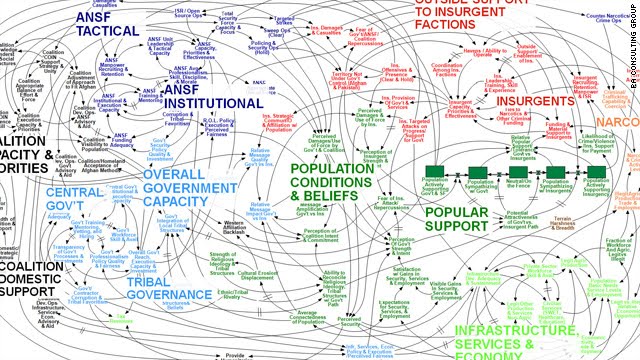
Col. Sellin's was just the latest in a series of complaints about the military use of slide presentations - you may recall public ridicule of the famously incomprehensible "spaghetti slide," and a recent New York Times article, that cited other officers just as frustrated with the emergence of the military bureaucracy's "PowerPoint rangers."

But PowerPoint isn't inherently bad - just misunderstood. And bad PowerPoint presentations aren't just a concern of the military. We've all sat through presentations - or suffered or even dozed through them. The truth is, most are poorly constructed and instantly forgettable.

Why does this matter? Because presentations decide elections, military strategies and multibillion-dollar business deals; they educate our children and they spread the ideas that shape society's most important goals and directives.

Ultimately, a presentation succeeds or fails on the strength of its message and how well it's told. And those elements have nothing to do with the brand of the software package involved in its production. You know instantly when you're watching a great presenter at work - you may even own the ShamWow to prove it.

Sometimes, presenters try to punch up weak content with stunts. I remember one speaker who rode onto the stage on a motorcycle - and promptly lost control and crashed. (He was okay.) Another presenter rappelled down to the stage like a mountain climber. I remember the stunts, but not the messages...

Unfortunately, the development of presentations is a skill that is rarely taught and for which few sources of best practices exist. Bad presentations kill ideas, waste money and impede progress. Great ones illuminate, persuade, generate consensus and spark action.

How do you create a great presentation? I've been in the business for 20 years, but until recently even I couldn't define the deep structures and elements of truly superior presentations.

My research into this question led me in unexpected directions. The answers I found had nothing to do with technology or the internet; they were revealed in screenwriting, Greek and Shakespearean drama, mythology and literature.

Great presenters employ the basic narrative techniques used throughout history to connect with audiences and move them to action and new understanding.

The presentations that work are not the ones with the most data or the most elaborate charts and graphs; the winners are those with the most compelling and convincing narratives.

We're a distracted, multi-tasking society. So presentations need to lure and re-lure an audience simply to keep their attention. Audiences are looking at the clock or fiddling with their handheld devices throughout a presentation. You don't connect with your audience by throwing information at them - you do it by taking them on a journey toward your perspective.

Whether you're a CEO, a salesperson, a general or a biochemist, you must understand how to connect with an audience, how to construct a powerful narrative argument, and how to visually display information for maximum audience comprehension.

I read recently that our nation is suffering a crisis of literacy, with only 35% percent of high school seniors able to read proficiently. Yes, you read that correctly (assuming you're not part of the 65% of high school seniors.) But literacy really means the ability to communicate effectively. For professionals and citizens in every strata of society, true literacy now includes the ability to communicate effectively through presentations.

The stakes could not be higher for our country. If corporate executives communicate poorly, businesses and the economy suffer, and jobs are lost. If teachers communicate poorly, our children don't learn and advance. If generals communicate poorly, our troops and their missions are put at risk. These are dangers we cannot ignore.'

Fate of the World

Sourced from the Fate of the World Facebook page


'“Fate of the World” is a nail biting set of global warming scenarios covering 200 years of Earth’s existence. At the heart of the game are 10 'Masterplans' where the player calls the shots for all mankind including 'Apocalypse' where the gut wrenching goal is to raise the planet’s temperature a lethal degree; 'Lifeboat' where the goal is to save only the player while abandoning everyone else to whatever catastrophes await them; and 'Utopia' where a player can try to build a perfect society while battling population growth.'

06 November 2010

The Power of Enough - Free Seminar Series

The Global Sufficiency Network invites you to participate in a unique tele-seminar series entitled The Power of Enough: Embodying Exquisite Sufficiency in Your Life and in the World.

This powerful and interactive event features key experts and luminaries sharing their wisdom about creating a life and a world of having, doing and being enough– and it’s all for FREE.

Register here: http://maestropath.com/poe

This FREE tele-seminar series will explore:

  • How to set yourself free from the unconscious, relentless context of scarcity, lack and limitation. Learn why you feel like you never have quite enough or even more importantly, why you feel like you are not (good, rich, thin, pretty, etc) enough as a human being.
  • Why a paradigm shift out of the global cultural context of scarcity is vital for creating a just, sustainable and fulfilling world.
  • How to experience yourself, your time, your money, your work, your families, your communities and all of the crises in the world from an empowered view of “enough”.
  • Why sufficiency is an exquisite experience of fulfillment, peace, gratitude, generosity, flow, courage, possibility and joy.


The Power of Enough Series offers seven separate 90-minute interactive tele-seminars.

The seminars will occur each Tuesday 9-10:30 am PT November 9- December 21. Here is the list of leaders in this series. As you can see, we have a large ensemble of powerful visionaries and movers and shakers:

Nov 9 - The Power of Enough: Why Sufficiency Matters with Vicki Robins, Jennifer Cohen and Kay Sandberg

Nov 16 - A life of Having, Doing and Being Enough with Wayne Muller and Claire Zammit

Nov 23 - The Sufficiency Movement and its Role in Changing the Course of History with Lynne Twist, Marilyn Levin and Miriam Hawley

Nov 30 - The Currency of Sufficiency: Having an Empowered Relationship to Money with Nogie King and Joel Hodroff

Dec 7 - A New Paradigm for the Business World – Why Enough Works with Gina LaRoche and Mike Anson

Dec 14 - Transforming Scarcity Conscious into Sufficiency Consciousness: The evolutionary context of a world that works with Victoria Castle and Craig Hamilton

Dec 21 - Sufficiency 2.0 with Joshua Gorman, Samantha Tan and Lora Lyons

Please do share this invitation with friends and allies - all are warmly welcomed to participate. If you can’t make the live calls, register anyway and the organisers will send you the recordings.

Co-sponsors: MaestroConference, MaestroPath, Global Sufficiency Network and The Currency of Connection

The Lesson of Kansas: Change Outcomes - Minds Can Follow

Reposted in full [because its so important] from Campaign Strategy newsletter, November 2010

'On October 18 New York Times reported [1] a remarkable success in cutting carbon in the USA. Under the heading 'In Kansas Climate Sceptics Embrace Cleaner Energy' it succinctly describes a major achievement in getting cities and communities to cut carbon by saving energy and using renewables. Not through advocating 'action on climate change' or by trying to change people or their values but through propositions that start from where people already are - in this case clearly Security Driven Settlers*, safety-oriented, authoritarian, mainly right wing, traditionalist and identity seeking.

In other words, by matching the asks and offers to unconscious values and the attitudes and beliefs that flow from them, the project succeeded in getting people we know from many surveys to be the bastion of 'climate scepticism' (eg [2]), to do exactly what legions of climate advocates want: to cut carbon.

Common Causes of Failure

So will climate campaigners learn from this? Some will - others won't, because they are bent on trying to also get people to act for "the right reasons". In other words, they are intent on trying to change people first, so that they become like the campaigners, and want to cut carbon for "ethical" reasons, rather than for instance to save money or because they find instruction in the bible (are told to by Authority) or because it helps protect them from foreign threats (oil imports).

I would call this the ‘ethical fallacy’. The latest and most elaborate exposition is in WWF UK's report Common Cause [3], of which more below.

In essence, the Common Cause argument is that people like us do the right thing, so we need to make other people into people like us. And they propose doing this, in essence, by talking to them, persuading, cajoling and arguing them into being "like us".

Common Cause states of ‘global challenges’ like climate change:

“It is increasingly evident that resistance to action on these challenges will only be overcome through engagement with the cultural values that underpin this resistance. It also seems clear that, in trying to meet these challenges, civil society organisations must champion some long-held (but insufficiently esteemed) values, while seeking to diminish the primacy of many values which are now prominent – at least in Western industrialised society.”

To ‘champion values’ is a notion which seems logical and greatly appeals to some inner directed Pioneers - especially the Concerned Ethicals, who have a dominant unmet need for ethical clarity. This they apply to any social problem, advocating that if only we explained the problem more clearly, fully and holistically, and got people to think ethically, they would change their minds and change their wrong behaviours.

In its recommendations, the largely theoretical Common Cause makes numerous suggestions for a form of political correctness in communications: ‘a series of principles that could come to inform civil society campaigns and communications’. For example it says:

‘Civil society organisations should lead the way in openly discussing the values that a campaign or communication seeks to activate, presenting for public scrutiny both the evidence that these values will help to achieve the aims of that campaign, and the ways that the frames they deploy will help to strengthen these values’.

and

‘Starting with civil society organisations themselves, all organisations should openly scrutinise the values that their activities promote, draw public attention to these, and outline the justification for working to strengthen these values’.

The only problem is that, for most people, this approach doesn't work. It’s a common cause of campaign failure, which the Common Cause recipe would only make worse. Forcing your values upon an audience which doesn’t share them, will only enable them to find more satisfying reasons why you are wrong, and whatever you proposed as an action will then be more deeply framed as ‘wrong’.

If it did work then Security Driven Settlers and Outer Directed Prospectors would long ago have swung into line with the bulk of Pioneers and agreed with the propositions of (Pioneer led) climate campaigns. For climate is a "mature issue": it's not new, people have heard about it, they have taken positions, they have made up their minds, and they have armed themselves with rationalisations about it which match their behaviours.

Indeed it is climate-campaigning and the media debates which it generates, that have mainly moulded these views. No values group was born with an in depth understanding of emissions scenarios or climatology. Their opinions on climate, which are so important politically, have been principally framed by the public politics provoked by campaigns, filtered through their values. And as those campaigns are primarily versed in universalist terms, with a heavy dose of non-acquisitiveness (giving stuff up or going without), they have succeeded admirably in provoking a response from 'people': A broadly positive response from other Pioneers; a mainly negative one from Prospectors and Settlers.


Similarly, we (my company CSL and KSBR) have found in focus groups across all values segments in the UK that the very word “environment” no longer denotes “your surroundings” but is interpreted as a political cause, and one that Pioneers tend to embrace and Settlers and Prospectors tend to reject.

The engagement of the Kansas Settlers by values-matching of propositions shows that it doesn't have to be like this. If we start from where other people are, and propose action which resonates with their attitudes and beliefs, it is possible to get 'climate action' but we have to accept that for many, it won't be for "ethical reasons".

Global Cool Shows How To Engage Prospectors

Of course the Settlers are only half the picture in terms of the conventionally ‘disengaged’. The other problem group for climate campaigns is the Prospectors. These are the people who the Concerned Ethicals love to blame the most. Fun seeking, hedonistic and fashion following, the Outer Directed Prospectors don't just look conservative and head-in-the-sand like Settler denialists, they positively revel in getting the latest must-have thing. If you've got, flaunt it, is a Prospector reflex.

This deeply dismays the Concerned Ethicals and they tend to respond by lecturing Prospectors about 'over consumption', and the need to lead better, more ethical lives. They often fail to connect with Prospectors because their favoured channels of communication are used mainly by Pioneers (eg the current affairs sections of 'serious' newspapers) but when they do connect, the effect is often to annoy.

Hence, as I've reported before in this Newsletter, the reactions to environmental campaigns from Prospectors along the lines of "if I hear one more thing about what I shouldn't do - my next car's going to be a Ferrari", or "I know we've got to save the planet but there's more important things as well" [verbatims].

Fortunately we also know how to get Prospectors to take 'climate action' by matching asks and offers to their particular values. The best example is the work of Global Cool [www.globalcool.org]: motivating the uber-Prospector 'Now People' group to turn down their central heating by following fashion and wearing jumpers, avoiding flying by using Eurostar for hedonistic holidays, incentivizing bus travel with lessons in how to chat up strangers, and cutting embedded carbon with Swishing parties.

Caroline Fiennes, Direct of Global Cool points out that it sells the action, not the problem. Unlike conventional ‘climate campaigns’ it doesn’t take you through the problem to get to the action.

At its ‘public engagement’ or front of house website, Global Cool describes itself as a ‘green lifestyle’ organisation. Not a ‘campaign’. See www.globalcoolfoundation.org for a more ‘rear of house’ website which gives a more conventional NGO explanation of the organisation.

So as this works, whereas preaching ethics doesn't, should more climate communications resources be targeted in this way? Obviously yes (as I have probably bored you with for years). But WWF UK disagrees.

Why Common Cause is Wrong as a Strategy for Campaigns

In Common Cause, Tom Crompton and others argue a form of moral hazard, in other words although this values-matching might work, it will have a perverse effect of reinforcing a bad behaviour because of its motivation, even if it's a good one in terms of outcomes. It's the motivation that Common Cause authors dislike: the desire for more, latest stuff or trendy behaviours. This, they argue, is a weaker basis for a good behaviour (eg which cuts carbon) than an ethical, internally driven or "intrinsic" one. They reject the pragmatism of Saul Alinsky who noted that the ‘right things’ are rarely done for the ‘right reasons’. Consequently there is nothing for it but a crusade to change the people.

This argument is fundamentally flawed for a number of reasons.

Reason One - Un-Met Needs Give Way Once Met

First, Maslowian needs are not conscious but unconscious, and the sequence of needs identified in Maslow's Hierarchy is not just a segmentation of needs but a sequence of un-met needs . We cannot change them by asking people to reflect - we cannot get Prospectors to become Pioneers by talking to them about it.

By the same token, once the underlying dominant unmet need is met, a new one takes its place. So if Settlers meet their needs for safety, security and identity, they become Prospectors seeking esteem of others, and then self esteem. If meeting a need (eg to belong or to be safe) simply reinforced that need, we would have a uniform population of security driven Settlers - they would not have developed a desire to find the esteem of others. It is this search for esteem which drives them to acquire and display symbols of success, which in our society has long taken the form of material goods and services, and which so annoys the Concerned Ethical subset of Pioneers.

So, if Prospectors meet that need by getting enough stuff and following sufficient fashion etc, they do not stay Prospectors but develop other needs - ie they become Pioneers. Does this happen? Yes - otherwise where did the 41% of the UK population currently inner directed (Pioneers) come from? Unless, as is not apparently the case, Crompton et al think Maslow was wrong and some people are born with these values. There is also substantial evidence that Maslow was right and that if conditions allow us to have the right experiences, we meet previously unmet needs and new ones emerge.

For example: - The attitudes and beliefs mapped in huge detail in CDSM's British Values Survey (1,000 questions put to 8,500 nationally representative adults) clearly map into the three main Maslowian Groups. Very similar systems have produced the same results in many other countries: for example the work of Shalom Schwartz in the Hebrew University of Jerusalem, Sociovison in France, and Environics in Canada.

- numerous cases of individual values transitions can be seen in everyday life, eg the fashionista celebrities and serial achievers who suddenly decide that "there's more to life than this" and get into ethical causes (ie have become inner directed Pioneers)

- in the UK there is a preponderance of Settlers and Golden Dreamers (entry level Prospectors) amongst younger teens, and the increasing number of Now People and Tomorrow People (later sequence Prospectors), and Pioneers, at student age. This is consistent with needs groups emerging as the population reaches adulthood and some move on from being Settlers, which all start as (ie all children are initially Settlers)

- inter-generational shifts in values have been mapped across whole societies, from Settler to Prospector and then to Pioneer, as socio economic change has improved conditions, as predicted and charted by Ron Inglehart [4] and others, and, eg in the UK, the recent drop-back of some Prospectors to Settlers in circumstances of recession**

So there is no reason to think that the dominant Maslowian needs of a person are immutable, and as meeting them causes new needs to dominate, that is not ‘a problem’. At any event it is infeasible for any campaign group to exert enough influence over existential conditions for any conceivable campaign plan could affect the unmet needs of large audiences. No campaign group is likely to have the resources to meet individual psychological needs - which requires providing people with experiences that have that effect - for any significant number of people.

Even so, do social conditions make it harder than is desirable for people to meet needs? That's a huge political question as it presages fundamental social engineering. Might for example it be that advertising and product development makes it harder for people to satisfy the need for stuff? Possibly so - and that might be one of a number of reasons why the US is a Prospector dominated society than those in NW Europe.

Yet even if this were the case, it is going to be far easier and so more practical to get Prospectors to undertake low carbon behaviours by making those behaviours generate esteem, as Global Cool do, rather than to try to change the entire commercial culture of a society to remove all products or services which are associated with environmental damage. Nice perhaps but wishful thinking.

In values terms that is the root of the debate over use of values - between what would be ideal and what can be achieved. I am obviously in the latter camp.

So, to revert to the case of Kansas, the Common Cause approach would say no, this is wrong - instead of getting Settlers from Kansas to cut carbon for their own reasons, we should be trying to convert them to universalist, ethical, holistic thinkers of the sort that you might meet at a Schumacher College seminar or in a Deep Ecology retreat. The Common Cause approach would also say it is wrong to be getting sociable, esteem seeking predominantly female, young and fun loving fashion followers to adopt green lifestyles, as Global Cool does, because they should be somehow educated out of their extrinsic motivations and persuaded to act for ‘intrinsic’ reasons. Common Cause doesn’t give any suggestion of exactly how this will be achieved.

Reason Two - Taking No Account of Strategy

The second main reason why I think Common Cause is wrong as a guide to campaigning is that it draws conclusions without taking account of strategy. Strategic change can be used to lock off the opportunity to undertake ‘bad’ behaviours in outcome terms. Indeed the whole point of campaign strategy is to get a big result with the greatest efficiency in terms of effort, assets and resources.

There is, for example, no reason why esteem-generating behaviours cannot be decarbonized. For instance, getting a car is obviously a status enhancing event in many places because it enables you to do many things, including social activities that are otherwise more difficult or impossible. That is a 'problem' if cars emit carbon but not if they are made electric and run on renewable energy.

Similarly, campaigns might aim to change markets so that ‘market forces’ drive a desired change. For example if the price of a product like a solar electric panel was dependent on scale, a campaign to drive down the price by market building and upscaling production, or to ensure a new technology was applied by breaking a new entrant into a market, might create a new market leader whose product would then dominate the market. If that was cheaper to own than other forms of power, it could then crowd out other sources of (more polluting) energy. Here the strategy would not involve changing decisions by all consumers but only a certain group, whose actions were enough to bring about the change in commercial activity which had the inevitable consequence of changing the market for good.

Electric Cars - Potential Perfect Storm

In fact of all the carbon-transition developments which we can now see are likely to happen anyway - that is, the opportunity will be created for campaigners rather than them having to initiate it from scratch - the entry of affordable, performance-comparable, conventional-brand electric cars onto developed-country markets is probably the most important. In a country like the UK, it is also imminent: electric cars are going to be on the mass market soon.

It is salient - as cars are ‘in my life’ for many people in a way that power stations or sea level rise is not - and it is tractable because cars are consumer purchases, and understood. It is clearly strategic as widescale adoption of electric vehicles forces or is constrained by power infrastructure and/or policy, and fiscal policy and interacts with mass popular culture. It has the potential to make oil look and feel un-necessary. The transition to electric vehicles has the potential to be a perfect storm of change in decarbonizing economies - all without having to ‘change people’. It is an example of how campaigns could bring about lock-in or close off options for behaviour, and to create aspiration, recommendation cascades and norms, if the campaigns are designed and targeted strategically.

In terms of achieving change therefore, even if it were possible, trying to ‘change the values’ of someone who might at some point buy a car, as a way to change the outcomes of car buying and use at a population level, would come way way down the list of strategic options for campaign design.

A strategy to exploit that opportunity means looking at and understanding the dynamics of car buying, and the commercial interests in play within the market and understanding how that interacts with government tax and subsidy and what signals will have an effect on politicians, officials, manufacturers, distributors, the business press and so on. We already know what social signals would best motivate Pioneers, Prospectors and Settlers to go out and get an electric car, and who to start with and how not to talk about the behaviour as well as how to do it.

Carbon itself could also be made unfashionable - desocialised. If carbon slimming became as aspirational as being physically slim, it would soon spread amongst Prospectors. Not easy to start but possible to achieve.

And most obviously but apparently ignored by Common Cause , no decent campaign strategy should set out simply to convert an entire population, one by one, as in the manner of government social marketing schemes. Indeed if that is the thinking behind Common Cause then WWF UK and its partners might better ask themselves why they are not more successful in engaging the 41% of the population who are not esteem-seeking Prospectors or security driven Settlers but Pioneers who are much more willing to think about ‘issues’ and accept personal responsibility for taking action on them.

It was once said that capitalism is the operation of the market without the intervention of human intelligence. To try to initiate campaigns without strategy is the equivalent in NGO terms - a broad brush crusade which will soon squander its resources and exhaust its assets.

Reason Three - Practical Politics

The third practical reason why campaigns should not be modeled on the Common Cause formula is that they won’t generate political space for population-wide measures. Politicians in government are only too aware that governance is the art of the possible and that they must bring along or gain consent from constituencies far wider than those who may have elected them.

Even if they are unaware of unconscious motivational values, and have never heard of Maslow, almost any politician, and even more a government with many officials, departments and agencies, is going to sense whether or not a proposition has broad support. That’s not just a question of numbers but of qualitative evidences - signs that ‘different types’ of people will accept it or want it. Which means that any campaign designed to sell a big political idea, as many (probably too many) are, needs to have some sort of support base amongst all three Maslow groups - Prospectors, Pioneers and Settlers. Politically and socially these people tend to look different, sound different, act different and think differently.

It is clear therefore that if your project sets out to tell Settlers and Prospectors that they are wrong to hold the values (expressed as attitudes and beliefs) that they do, and instead should think like Pioneers, you are going to generate rejection and debate rather than signs of agreement and support. Politically you will simply create evidence that your idea is not a flier, has no legs and is a difficult political cause, best avoided.

If you doubt this and sympathise with the sentiments in Common Cause, then try a simple thought experiment. You will probably have heard of the Tea Party. They scarcely could have had more publicity than they have in the past year or so. So you will have become at least as aware of their values, attitudes and beliefs, as they will be of yours. And most Tea Party approved candidates at the recent US Elections were hostile to the ‘global challenges’ embraced by the authors of Common Cause, eg climate change. So are you persuaded? They have been vocal in promoting their ‘values’. Did it make you agree with them? Think they are right? If so, then maybe Common Cause is correct but I find that unlikely.

As it happens, we do know something about the values of the Tea Party. A recent US study using samples gathered via Facebook and asking questions which enable mapping of values in terms of the ‘Schwartz dimensions’ (much discussed in Common Cause), surveyed supporters of the Tea Party, the Democrats, and the Republicans, and can be compared against UK political affinity results (previous CDSM surveys reported at www.campaignstrategy.org and www.cultdyn.co.uk - CDSM pers comm).

If you take Universalism for example, which most strongly correlates with the values championed by Common Cause, the proportion of the total US population aged 18-60 in the top quintile on that value is 20.3%, and the UK figure is 19.6%. These people are most like those who Common Cause would describe as having ‘helpful’ values. But if you look at the Libertarian wing of the Tea Party, only 6.7% fall into this bracket - an astonishingly significant result, and an even more microscopic 1.4% of the Religious wing of the Tea Party do so. A pretty steep hill for the Common Cause approach to climb then - as opposed to going the Kansas route. In communications terms it might be a noble endeavour to try and change these people into ethically minded greenies but it is a futile exercise.

(By comparison the UK (affinity to) Conservative Party score is 11.4%, Labour 22.9%, and the Liberal Democrats 25.4%. Only the BNP at 4% look similar to the Tea Party in this respect). Tea Party adherents from the two wings of Libertarians (angry Prospectors) and the Religious (scared Settlers) themselves are split by a values antagonism from stimulation to tradition and conformity but that is another story, which Cultural Dynamics will tell.

The Minds Will Follow

There are also intensely practical reasons to believe that it is more effective to change outcomes in order to lead opinion, rather than to try and ‘change minds’ at the level of deeper attitudes and beliefs. These apply even if you not fully accept the above arguments about values.

An article [5] in Organizational Dynamics recently triggered a round of confused debate about values and behaviour but in two respects the author (Andrew Hoffman) is certainly right. As he said in an email "We live in a world where scientists can talk until they are blue in the face ... but if businesses pay money on it, people will think it must be true". That particularly applies to the way Settlers and Prospectors construct proofs and truths, as has been seen in countless qualitative research and framing projects. It’s the same rationalisation reflex which led many people to conclude after the ‘failure’ of world leaders to agree much at the Copenhagen climate talks, that there couldn’t after all, have been much to agree (or worry) about.

As Hoffman says, like cancer and smoking and the abolition of slavery, an issue, a contested topic, has to mature into ‘social fact’ for wholesale change on it to be acceptable. This is why campaigns ‘on climate’ should, as argued in previous editions of this Newsletter [6], focus on generating those signs, of showing that the response is real, happening now, and mainstream. The material is out there - in the burgeoning ‘green’ industries and jobs (particularly renewable energy) - it needs to be made to resonate and connect with people’s realities, especially Settlers and Prospectors, to be opened up and laid out to see, to be felt and experienced, to be made to count in daily life, so that it becomes experienced as the norm. This is not what conventional campaigns do but it is what they should do now.

It’s the consistency principle or ‘heuristic’, also described in earlier editions of this Newsletter [7], which lies at the heart of this process. Opinions change to stay in step with behaviours. Life and lifestyle has to make sense for it to be tolerable and satisfying, so what you do must make sense, so if government and business are doing renewable energy, and if you are using it yourself or you know a friend, relative or neighbour who is working in it, then it becomes a reality “that works”. The connection to the underlying cause then comes not analytical and reflective and open to debate but accepted as the way things are. Up until recently this worked in favour of fossil fuels, the oil industry and the “climate problem”. Every time you filled up your car with petrol or diesel you were reinforcing the notion that we need to keep on using this stuff. Now there is the potential to make it work the other way around.

* See www.cultdyn.co.uk and Using Values Modes at this website for an introduction to Maslowian values analysis, or http://bit.ly/asEXdn

** but not from Pioneer to Prospector, as consistent with a one-way transition on achieving self-esteem


[1] http://bit.ly/aBvPY8 New York Times article, In Kansas Climate Sceptics Embrace Cleaner Energy

[2] www.campaignstrategy.org/whogivesastuff.pdf

[3] www.wwf.org.uk/wwf_articles.cfm?unewsid=4224 Common Cause: The case for working with our Cultural Values, Tom Crompton et al 2010

[4] Ron Inglehart and Christian Welzel, Modernization, Cultural Change, and Democracy: The Human Development Sequence published Cambridge University Press, 2005

[5] Climate change as a cultural and behavioural issue: Addressing barriers and implementing solutions, Andrew J. Hoffman, Organizational Dynamics (2010) 39, 295—305 www.eenews.net/assets/2010/10/28/document_cw_01.pdf

[6] See for example Campaign Strategy Newsletter 57 and www.campaignstrategy.org/climate_campaigns_keep_calm.pdf

[7] www.campaignstrategy.org/articles/VBCOP_unifying_strategy_model.pdf

Steady State Alternative to Endless Economic Growth


Geoff Mosley, former CEO of the Australian Conservation Foundation and steady state economics advocate, has released a book available through Envirobook

Steady State, Alternative to Endless Economic Growth

Author : Geoff Mosley
ISBN(13) : 9780858812390

The economic growth obsession that dominates our lives cannot go on for ever. Our world is finite and has limits. Sooner or later, one way or another, this way of life must end. But what is to replace it and how can we make the change?

Geoff Mosley describes the making of the change to a creative and dynamic steady state economy as the most important in human history. In this book he makes the case for an alternative offering a future characterized by fairness and freedom, outlines its main features and discusses the steps we need to take to make the transformation. In the last part of the book he provides campaign advice for the emerging steady state movement.

RRP AUD$21.95, 136pp, pb

In the author's own words:

'Most people are aware that the condition of the global environment is rapidly deteriorating but what is to be done about it? The reality is that there is a common cause of this situation – the commitment of our societies to endless economic growth. For many years Dr Geoff Mosley has been considering how best to attack this problem at its heart - by dealing with the cause and not just the effects. His ideas are now available in his book Steady State Alternative to Endless Economic Growth. Published by Envirobook the book is available for $21.95 either from the publisher (sales@envirobook.com.au) or, from the author (jandemosley@bigpond.com).

Geoff Mosley is probably best known as the former long term CEO of the Australian Conservation Foundation. In 2008 the United Nations Association of Australia selected him as their environmentalist of the year for work which included his efforts to promote the steady state economy alternative. He is the Director of Operations, Australia for the Center for the Advancement of the Steady State Economy.

Geoff believes it is time to choose – to stop the make believe and start to work for a better world. His book is a practical navigation guide to another country – our own future – and the target audience is YOU. Not only that but when you have read it the author would welcome your own ideas on how to chart our way through the difficult terrain which lies ahead in the long journey to sustainability, justice and peace.'

04 November 2010

Design for Life - The Food Forest Story

Filmed in and around Adelaide, South Australia, 'Design for Life - The Food Forest Story' tells the compelling story of two young baby-boomers who travelled the world questing for a sustainable way for humans to live on the planet. They adopt the Permaculture design system and build an amazing organic home, farm and lifestyle.

The World Premiere will be held in Gawler on 15 November at 7.30pm, and a city screening will be held on Tuesday 7th December at 5.30pm at the Mercury Cinema, 13 Morphett Street, Adelaide (actual screening at 6.00pm), price $20 per ticket - including drinks and nibbles from The Food Forest.

Tickets and further info from The Food Forest

The Food Forest is being developed by Annemarie and Graham Brookman and their children Tom and Nikki, to demonstrate how an ordinary family, with a typical Australian income can grow its own food and create a productive and diverse landscape.

Symbionomics: Stories of New Economy

Check out what the creator of The Money Fix, is up to with his new film Symbionomics - stories of a new economy...

'Is the economy just in a recession or is their a bigger transformation afoot? Symbionomics is a media project about the new economy.

Symbionomics is a media project about the new economy. As we face unprecedented global challenges, people all over the world are fundamentally reimagining economics. We’d like to capture visions, ideas, and experiences that tell a new story.

Part of the new economy is about working in an open and collaborative way, so we’re taking that to heart in our approach. We are creating an online space that is like a virtual campfire where people around the world can share their stories and ideas. To seed this space, we will gather ten high quality interviews with leading experts in the field. We will release these videos under a Creative Commons Attribution Share-Alike license so that anyone can remix them...'

31 October 2010

'Shrinking' the Climate Problem

Reposted in full from the New York Times, 28 October 2010

'I’ve written here before about the substantial part of the climate challenge that isn’t out in the world of greenhouse gases and coal furnaces, but within the human mind.

Still, I was intrigued earlier this month when I heard from Renee Lertzman, a research fellow in humanities and sustainability at Portland State University, that she was speaking on “the myth of apathy,” the subject of a book she’s writing, at “Engaging With Climate Change: Psychoanalytic Perspectives,” a meeting of psychoanalysts and behavioral researchers in London.

In regarding the polarized, confused, paralyzed discourse around global warming for more than two decades (including my own focus on the field for so long), I’ve sometimes thought that Freud would have had a field day in this realm. Now his successors may be starting to dive in. (The photograph below is from the Freud Museum in London.)

Lertzman sent a link to the “Beyond the Couch” Web site of the Institute for Psychoanalysis, which held a fascinating list of talks at the meeting, including “Unconscious obstacles to caring for the planet,” “Engaging with the natural world and with human nature” and “Climate change denial in a perverse culture.”

I invited Lertzman to send a Dot Earth “ post card,” which you can read below, followed by a brief set of followup questions and her replies:

I’ve just returned from speaking at the international headquarters of psychoanalysis, the Institute of Psychoanalysis, established in 1913 in London…. I imagine this was the first time eminent psychoanalysts, environmental professionals, activists and scholars have gathered within these hallowed halls to contemplate our current environmental predicaments. For two full days, almost two hundred people came together to “shrink” the climate change crisis….

Psychoanalysis may be most popularly known as an insular and esoteric relic of the Victorian era. However, it’s come a long way since Freud; this event ably demonstrated that psychoanalysis is an essential voice on these matters. At least it is, if we want to address the messiness of how the human mind can cope with such overwhelming issues.

What are the unconscious dimensions of climate change? Is it possible that anxiety and fear are profoundly impeding our abilities to respond proactively and creatively to our impending crises? How can we explain the inertia and paralysis on the part of both the public and our politicians?

While most psychological research on climate change is fixated on attitudes, behavior and cognition (i.e. barriers to action), psychoanalysis is mainly concerned with the ubiquity of the unconscious in everyday life. The concept of a “barrier” or “apathy” dissolves, as it’s assumed we all have conflict, ambivalence, contradictions — the bread and butter of psychoanalytic theory.

Topics ranged from consumption, identity and our disavowal of the human dependence on nature to issues of loss and mourning as we face a new relationship with oil, and the psychic complexities of inaction.

I was delighted to witness this historic event and the sense that finally, after much time, psychoanalysis was finally able to take stock of its environment and life outside of the consulting room. The psychoanalyst Hanna Segal wrote two decades ago about the insidious silence in the psychoanalytic community on political and social travesties.

Now it appears the silence may be breaking, and we can glean what we can from those whose work is about resistance to change, loss and mourning, anxiety and denial. We need these perspectives. I hope this signals a shift in the right direction.

I followed up with some questions:

Q.

So what is the “myth of apathy” in the context of human reactions to the science pointing to a building risk from human-driven climate change?

A.

The myth of apathy is the idea that apathy itself is a misleading and damaging concept, and tells us nothing about why people may find it difficult to take in, or respond to, human-driven climate change threats. The label of apathy presumes “what you see is what you get.”

Those working in psychotherapeutic fields know that nothing can be further from the truth. So reframing the myth of apathy presumes care and concern. The mantra in environmental sectors is, “We have to get people to care.” The “myth of apathy” presumes people do care but we need to consider how to support, channel and foster that care. This means investigating what may be complicating our creative and reparative impulses.

This includes recognizing that how we manage anxiety, particularly unconsciously, can lead to numbing, denial, projection (it’s all their problem), victimization (and I am not speaking of actual victims here) and so on. Psychoanalysts called this “splitting” — the ability to split up the world and our internal experiences so we don’t have to feel anxiety, pain or fear. If we leverage tools from the psychotherapeutic and psychoanalytic disciplines — such as how to support people in facing the truth about ourselves and our lives without “splitting” — we begin to see that what we may need to be doing is attending primarily to anxiety and loss first and then figuring out how to change behavior, second.

At the moment, we seem to have it the other way around, and are focused mainly on engineering human behavior, without consideration of unconscious, affective dimensions of these extremely challenging and often frightening problems. We need both: attention to “barriers” to action, and acute sensitivity to what may be happening emotionally that makes this so difficult. A psychoanalytic perspective places these dimensions in the foreground, and assumes that if we get to the root of the matter, behavior change will follow. Psychological work in this area, while important, continues to focus on conscious dimensions and behavioral change.

Q.

Were there any powerful take-home points from the session on unconscious obstacles?

A.

The most powerful take-home points were John Keene’s comments concerning anxieties when faced with actual limitations that climate change and other serious environmental issues present (i.e. our exploitation of non-renewable resources). Keene joins this up with how humans behave in groups, and how groups function to help manage our anxieties. Keene noted, “Many commentators are surprised at how difficult humans find it to change their behavior on the basis of sensible advice or of learning from experience. Facts are troublesome – stories and ideologies are easier.”

We often turn to others in social settings for stories and ideologies to help manage anxieties and seek comforting answers. Keene contends, “While thinking is hard enough for an individual in quiet contemplation, thinking clearly and acting in a group setting generates anxiety roughly in proportion to the size of the group. Here the individual is exposed to the risks of shame and criticism, isolation, fears of loss of one’s identity or at worst losing one’s mind. Our moral functions (super–ego functions), which push us to act in accordance with our ideals, and guard us from self-harm, operate largely out of awareness but become conscious as the voice of conscience or a sense of anxiety or alarm.”

Keene continues, “As I have suggested there is a universal tendency in group life for individuals groups and cultures to find people, structures and ideologies into which they can project their responsibilities in order to return to a childlike state. The cultural expectations that we grow in are the medium in which our individual super-egos swim and develop. As the world economy and its dominant business models drive the present surge towards growth with increasing pressure on the earth’s resources, this is probably the place to start to look at hope for the recovery of the world patient.”

All of this speaks to the fact that guilt, blame and moralizing don’t get us very far; that groups can actually hinder constructive environmental action; and that anxiety may be the largest unconscious obstacle to action (which is the theme of my work as well).

Q.

What was your reaction to the session on climate denial in a perverse culture? what was the nature of the “perversion”?

A.

“Perversion” here means something entirely different from what we commonly think of as perverse (i.e. “perverted”) — and is apt for thinking about how our culture is responding to human-driven climate change material. Paul Hoggett discussed how perversity (as a psychoanalytic concept) is a form of cultural behavior that functions in preventing coming to terms with loss — where outright rejection of reality becomes tenable. It is related to denial, but more insidious as a mode of conduct that is pervasive in corporate culture and particularly the financial institutions.

Hoggett drew on Susan Long’s work, The Perverse Organization and Its Seven Deadly Sins, as it applies to how we are dealing with climate change. The “sins” include prioritizing individual pleasures, instrumental relationships, and the collusion of others in the denial of reality. This is considered “perverse” behavior and has become normalized in our culture. At its essence it is an avoidance of reality on a massive scale, and an indulgence in omnipotent fantasies in order to avoid any sense of loss or sacrifice. Less clear is the antidote to a perverse culture — but we can imagine it relates in part to the support of intrinsic values, constructive group discussions and a recognition of the problem.

Q.

My sense is that real action to change course on trends that matter (energy choices, balancing engineered and ecological systems) will only come if humans move away from “woe is me” and “shame on you” in considering environmental challenges and look inward for the source of problems — and solutions. Does your work, and the discussion at this meeting, reinforce or challenge that view?

A.

These perspectives certainly reinforce the notion that we must look “inward” for the source of the problems: how we got into this situation in the first place, what sorts of mental, emotional, social and cultural forces shape our relations with nature, and what may be impeding our capacities for creative, reparative responses. A psychoanalytic view accepts that taking a moralizing or punitive tone supports the super-ego — our internalized task master — which leads usually to outright rebellion, and doesn’t get us very far. The same goes for using scare and alarm tactics.

My work, and the views reflected at this meeting, advocate both acknowledging the frightening or difficult aspects of these issues, and finding techniques to help people tap into our huge creative capacities. It’s a solutions approach but recognizes the emotional aspects of how we get to solutions. Our technological innovations require “engagement” — and “engagement” is about our emotional and affective investments in the world. The British psychoanalyst Donald Winnicott wrote about our capacity for concern as the basis of an ethics; that we have these capacities but they are fostered through creativity (and what he calls “play”).

So yes, it’s about looking inward with as much compassion as we can muster. Think of the therapist and the patient; does the therapist admonish the patient? Or provide support for facing the difficult truth? And then setting about finding creative avenues for action and collective responses.'

Are Accountants the Last Hope for the World's Ecosystems?

First thoughts on this article's headline - heaven help us!

Second thought - have we lost the ability to make decisions on ANY basis other than a monetary/financial basis? Are we seriously going to have to try to value nature in order to be able to afford to save ourselves?

Third thought - we do need bean counters...but the ones who count the REAL beans, the people from Global Footprint Network, who maintain national biophysical accounts with thousands of data points using FAO and IPCC data that track human demand on natural capacity...it doesn't give us the whole picture (no one indicator does), but its an existing, robust data set.

Reposted in full from The Guardian, 28 October 2010

'So it has come to this. The global biodiversity crisis is so severe that brilliant scientists, political leaders, eco-warriors, and religious gurus can no longer save us from ourselves. The military are powerless. But there may be one last hope for life on earth: accountants.

Ecological bean counting may not seem to hold much power in slowing the massive loss of the world's species, but it appears to be moving up the agenda of the UN biodiversity conference in Nagoya as the economic implications of losing ecosystems becomes more apparent.

On tables covered in press releases and briefing papers, the references to "natural capital", "biological resources" and "eco-financing" outnumber images of flora and fauna. It feels as if biodiversity is now attracting as many money men as nature lovers. That can't be right, can it?

One of the major challenges facing the natural world is that its services have been taken for granted, economically speaking. We don't adequately value fresh air or clean water. The destruction of lakes, grasslands, forests, marshes, mountains and wildlife populations rarely appears on corporate or national balance sheets.

Addressing this problem through smarter eco-accounting has been the goal for many environmentalists for several decades. But progress has been slow because it is extraordinarily difficult to measure the value of nature.

But that is starting to change as tools and techniques are developed to assess "environmental services" such as carbon sequestration, water cycle regulation and – to a less clear extent – climate maintenance and habitat provision.

In Nagoya, there has been a concerted attempt to promote, extend and improve environmental economics and to draw more financiers and business executives into biodiversity valuation and protection.

In the past week, we have seen the most comprehensive UN estimate yet of the worth of nature – The Economics of Ecosystems and Biodiversity (Teeb) – which calculated the global impact of biodiversity at between $2-4.5 trillion (£1.3-2.8tn) annually, up to 7.5% of global GDP. A separate study noted the importance of ecological risk assessment by financial institutions. Today, we also saw the World Bank president, Robert Zoellick, talking of the need for businesses to be involved in conservation and, most intriguingly, launching a new programme to embed environment costs into national accounts.

The five-year pilot project – partly funded by the UK and backed by India and Mexico – would use new accounting tools to measure the value of ecosystems so that, theoretically, there would be more of an incentive to protect them.

A myriad of other initiatives are under way. The accountants PwC unveiled a study today on "habitat banking". The Global Canopy programme, which is an alliance of scientists, has been issuing "Little (pink) Biodiversity Finance books" which show ways to invest in natural capital. China is also working to recalculate the value of its environment as I reported this year.

Such experiments are both thrilling and disturbing. For those who cherish the natural world regardless of its price, the idea of eco-accounting may prompt unease. Similarly, it will stir up suspicion among people who believe nature should be left as a public resource. But current conservation strategies are not enough. New ideas are needed.

Eco-accounting alone can't solve everything but I will watch with great interest how these initiatives develop. Making them work will require boring things like measuring, standard setting, regulation and checking. But the potential consequences are enormous. Done badly, they could mean the natural world is further commodified, priced, sliced and sold to the highest bidder. Done well, they could reset human values and, who knows, perhaps transform capitalism more than they change the natural world.

Accountants as agents of revolution? Now there's a thought.'