22 January 2011

Microcredit: The Good, The Bad and The Ugly

Insightful piece by David Korten on the hijacking of microcredit, and interesting comparisons with what has happened to banking in the 'developed' world...

Excerpt from YES! Magazine, 19 January 2011

'...Once praised as a universal panacea, microlenders are now being widely attacked as predatory loan sharks. In December 2010, Sheik Hasina Wazed, the prime minister of Bangladesh and former microcredit advocate, accused microcredit programs of “sucking blood from the poor in the name of poverty alleviation.”

What happened?

It turns out there are two very different models of microcredit. As Muhammad Yunus, winner of the 2006 Nobel Prize, point ed out in his January 15, 2011 New York Times op-ed, one type of microcredit program is designed to serve the poor; another to maximize financial returns to program managers and Wall Street investors...

Microcredit programs seeking to replicate the Grameen model have spread rapidly across the globe. Most, however, replicate only the loan feature. Few provide their members with depository services or replicate the Grameen Bank’s other defining features, though these features are central to its commitment to community wealth building.

The microcredit experience brings to light a larger principle: the institutional structure of a financial system determines where money flows and who benefits. In short, structure determines purpose.

The transformation of microcredit institutions from a model that serves communities to a model that is “sucking blood from the poor in the name of poverty alleviation” mirrors a similar transformation of the U.S. banking system, which occurred through the process of banking deregulation that began in the United States in 1970s.

Throughout the 1940s, 50s, and 60s the United States had a system oflocally owned and strictly regulated community banks, mutual savings and loans, and credit unions, many of them organized on a cooperative ownership model much like the Grameen Bank. They were organized and managed to serve the financial needs of the communities in which they were located and kept money flowing within the community in service to community needs.

Banking deregulation over the past 30 years led to a wave of banking mergers and acquisitions that created too-big-to-fail Wall Street banks devoted to maximizing financial returns to Wall Street bankers and financiers. Rather than supporting local wealth creation, the system now sucks money and real resources out of the community. Both the microcredit experience and the aftermath of the 2008 Wall Street financial crash vividly reveal that the values and interests of Wall Street stand in fundamental opposition to those of Main Street.

Financial institutions can serve communities in pursuit of a better life for all or they can serve global markets to maximize financial returns to Wall Street bankers and financiers. They cannot serve both.The world does not need more predatory lenders in service to Wall Street. We all need more local, cooperatively owned community banks on the model of Grameen.'

Earth Smarts - Essential Ecoliteracy


Sourced from
Earth Smarts, January 2011

'Earth smarts, or essential ecoliteracy, is like street smarts writ large - it helps individuals and communities to survive and thrive in the world. Essential ecoliteracy is an education construct that is:
  • theoretically sound
  • apolitical
  • flexible enough to be useful across different cultures and ecosystems
  • flexible enough to encourage teacher localization and creativity
  • focused enough to be practical in modern, standards-based classrooms

Essential ecoliteracy answers the question: What set of qualities do we need to justly maintain, or improve, our quality of life beyond the short term?

This is important for a couple big reasons. For starters, many societies live in unsustainable ways, which threatens their wellbeing, as well as that of other people and species. Over the course of human history, many such societies have collapsed, often disastrously. But earth smarts is also important because we are realizing that the world changes, sometimes quite rapidly, and we need to be able to adapt to those changes to maintain our quality of life.

So it doesn't really matter if you are conservative (I want to keep what I have),progressive (I want to change things for the better) or something in between - achieving essential ecoliteracy, having "earth smarts", will help you and your community keep or improve your quality of life in a fair and just way.

But what does a modern individual or community need to know? What skills do we need in an increasingly crowded, urban and technological world? Essential ecoliteracy emerged from an extensive, transdisciplinary literature analysis, with a focus on educational goals that are achievable.

1. Concepts (Knowledge, Content)


Basic Thermodynamics

Especially an understanding of the second law (entropy).


Ecological Principles

A holistic understanding of some of the key concepts of ecological science, including energy flow, biogeochemical cycling, population dynamics and food webs.


Historical Ecology

A general understanding of the complex interactions between people and their environment, including a sense of historical time and human history that examines some of the successes and failures of societies to adapt to their environments. Also includes concepts such as ecojustice, pollution and health, and the precautionary principal, as well as ecological economics, focusing on environmental services, resource management and use of the commons. An important theme is understanding that human/environment interaction works in both directions; we don't just react and adapt to the environment, we can actively change it (deliberately or not, for better and worse).


Essential Biology

Including a sense of time over evolutionary scales, an understanding of evolutionary processes, and an appreciation for both the unity and diversity of life.


Essential Earth Science

A sense of geological time, as well as a general understanding of key earth processes including plate tectonics, oceans, the water cycle and climate, weather, and the atmosphere.


2. Competencies (Skills, Abilities)


Self-Regulation/Adaptability

Perhaps the most important competency, this gathers a number of learning skills and attitudes. Change is inevitable, and adapting to change is necessary to maintaining quality of life. From an educational perspective, self-regulation can be considered as lifelong learning.


Community Skills

To meet the considerable challenges we face, we need to work well together. Community skills include democratic participation, argumentation, collaboration and collective intelligence, practical ethics, communication, conflict resolution and the ability to consider multiple perspectives and stakeholders. The specifics of these skills will vary considerably across cultures.


Scientific Reasoning

When done right, science is very effective at identifying problems and finding solutions. Not everyone needs to be a scientist, but we all benefit from some science-based skills and attitudes. They include an understanding of the nature of science, as a process and a way of thinking, as well as critical thinking skills, a realistic sense of scientific uncertainty, open-minded skepticism, creativity and investigation skills.


Systems Thinking

Linear and static thinking continue to lead us into trouble. Our societies and environments are complex systems, and to better understand them we need to nurture systems thinking, including connections & interactions, risk, consequences & implications, complexity and change.


3. Values (Ethics)


Moral Development

Sustaining your quality of life without needlessly diminishing that of others requires moral development. We need to move from the preconventional dualism of children to higher stages that incorporate commitment with uncertainty.


Respect for "Other..."

Justice and wellbeing for all requires us to respect others. What's more, we have learned from engineers and ecologists that diverse systems are more resilient, so biological and cultural diversity is important.


Justice

Earth smarts is based upon justice as fairness. As the world's most intelligent and influential species, we need to balance the tension between the rights of individuals and our responsibilities to our communities. This is a complex moral issue - there isn't a "right" way to do it, and societies can and do approach it differently.


Cultures

There is no "right" way to live - enabling a diversity of cultures allows us to learn from the social structures and experiences of others, and makes us more resilient to change. Note this is not relativism - some societies are decidedly more sustainable, and have higher wellbeing, than others.


Organisms

Biodiversity is a storehouse of information with both intrinsic and extrinsic value - we need to stop shortsightedly diminishing it.


Ecosystems

Simply preserving genetic information isn't enough - species are constantly adapting to their environments, and we need to nurture both.


Generations

We need to respect the wisdom of previous generations and the potential of future ones - our wellbeing must not needlessly jeopardize that of our grandchildren.


4. Sense of Place (Awareness, Affect, Emotions)


Awareness of Local Community incl Issues

In our mobile, technological societies, people can be amazingly ignorant of their local environment; such ignorance is not bliss, and often contributes to needlessly unsustainable lifestyles.


Awareness of Global Community incl Issues

Even the best local knowledge is no longer adequate in the face of global environmental change and threats.


Emotional Bond/Biophilia/Sensitivity

Whatever you call it, an attachment to the land is important - we need to care about our homes and surroundings. This connection may be some combination of spiritual, religious and aesthetic factors, and culture obviously plays a huge role. Many modern education systems do not address this well at all, sealing children in "safe", sterile classrooms for their entire development.


Self-Efficacy

Fatalism can be detrimental to our wellbeing - people need to understand they can, and do, have an effect on their environments. Knowing that, we can work to minimize our negative effects, and encourage positive ones.'

Food Crisis as World's Soil 'Vanishes in 60 Years'

...but we can innovate? Right? Use technology? Who needs soil anyway?

Excerpt from The Telegraph, 21 January 2011

'Fertile soil is being lost faster than it can be replenished and will eventually lead to the “topsoil bank” becoming empty, an Australian conference heard.

Chronic soil mismanagement and over farming causing erosion, climate change and increasing populations were to blame for the dramatic global decline in suitable farming soil, scientists said.

An estimated 75 billion tonnes of soil is lost annually with more than 80 per cent of the world's farming land "moderately or severely eroded", the Carbon Farming conference heard.

A University of Sydney study, presented to the conference, found soil is being lost in China 57 times faster than it can be replaced through natural processes.

In Europe that figure is 17 times, in America 10 times while five times as much soil is being lost in Australia...

Latest forecasts predict the world's population will grow from 6.8 billion to more than 9 billion by 2050, placing even further pressure on food production and farming.

The world last year faced a cereal crisis as wheat stocks dropped to a 30-year low after demand for wheat and rice outstripped supply for the past six out of the previous seven years.

This resulted in grain prices rocketing, which sparked civil unrest in many countries...'

21 January 2011

Climate Change Growing Risk For Insurers: Industry

Excerpt from Planet Ark, 20 January 2011

'Insurers are struggling to assess the risks from climate change, industry officials say, with the floods in Australia and Brazil highlighting the potential losses from greater extremes of weather.

Scientists say a warmer world will cause more intense drought, floods, cyclones as well as rising sea levels and the insurance industry says the number of weather-related disasters has already soared over the past several decades.

Adding to the risks is a growing human population, more people moving into cities, particularly in Asia, and more property in the path of increasingly volatile weather.

This makes it harder to tease out a direct climate change link in ever rising losses, experts say. Lack of long-term weather data in some parts of the world is also clouding the picture.

Another problem is the narrow time horizon insurers typically focus on. Reinsurers, for instance, renew their contracts annually based on past losses, meaning they aren't so concerned about trends decades in the future.

"There is still a fair amount of uncertainly as to climate change and the attribution of climate change to natural events or man-made and therefore it has not translated yet into the pricing," Yves Guerard, secretary-general of the Ottawa-based International Actuarial Association, told Reuters...

Rapidly growing megacities were a major concern for the market, he said, pointing to UN data showing 231 million people living in cities in Asia in 1950. By 2050, that figure is forecast to grow to nearly 3.5 billion."

Increased exposures with megacities coming up, low insurance penetration and key exposures being in emerging markets where most of the insurance growth has been happening. That's a time bomb," said Jan Mumenthaler, head of the International Finance Corporation's insurance services group.

In Australia, rising coastal urbanization and a rapidly expanding mining sector means a growing risk of weather-related insurance losses. The government has said the floods since last month are expected to be the nation's costliest natural disaster, with damage and reconstruction estimates between $5 billion and $20 billion...

Munich Re says the number of weather-related natural catastrophes has more than doubled since 1980.

Overall losses from weather-related natural catastrophes rose by a factor of 3 in the period 1980-2009, taking inflation into account, while insured losses from such events increased by a factor of about 4 during the same period. Total insured losses from natural disasters in 2010 was $37 billion, it says...'

Shot Across the Climate Change Bow

...a taste of what partial inundation of a major capital city looks like...what we can't tell from the photos is what it feels like.

Sourced from the Australian Broadcasting Corporation, 17 January 2011

'High-resolution aerial photos taken over Brisbane last week have revealed the scale of devastation across dozens of suburbs and tens of thousands of homes and businesses.

The aerial photos of the Brisbane floods were taken in flyovers on January 13 and January 14.

Hover over each photo to view the devastation caused by flooding.'

Riverside (Brisbane CBD): before flood

Riverside (Brisbane CBD): during flood

Rocklea: before flood

Rocklea: during flood


Fairfield: before flood

Fairfield: during flood

Why Food Security Must Be Viewed as a Strategic Threat - British MP

Laura Sandys is a Conservative MP for South Thanet

Reposted in full from The Ecologist, 18th January, 2011

With cheap food pricing, over-reliance on imports, and the pressures of a growing population, the UK's food security is set to rise up the national agenda. The Coalition Government must be prepared for the challenges aheadFor too long we have been avoiding one of the biggest threats to this country’s domestic security – food. Deluded by cheap food prices, importing over 50 per cent of what is on our supermarket shelves, and dismissing the calls from UK farmers and fishermen to focus more on national food production; food insecurity is an issue set to rise up the national agenda. It is time that Government understood and prepared for the challenge ahead.

I am pleased that our Government scientists are taking the issue of food security seriously with the future launch of the Foresight Report on Global Food and Farming Futures. Following a 20 per cent drop in Britain’s food self sufficiency over 10 years, the report will constitute an important and timely step in addressing the threat to Britain’s food security. Only last week, the UN’s Food and Agricultural Organisation reported record food price hikes of 4.2 per cent - double the national wage increase.

Food is a truly globalised business – a fact which enhances Britain’s vulnerability given its reliance on food imports. Events in recent weeks will undoubtedly be reflected in our pockets. Australia – the fourth largest producer of wheat – has lost tons of its crops in floods; conflict in the Ivory Coast has limited cocoa exports; and poor harvests due to La Nina have reduced global food supplies. Such events reflect in world food prices and result in greater unpredictability in securing food staples.

A new era of trade protectionism in food could well be on the horizon - not for economic gain, but to ensure domestic stability. Policy makers have perhaps lost sight of the domestic, regional and international tensions that could arise should access to food be curtailed. Only last week, the rising price of onions resulted in India banning exports to Pakistan which worsened tensions with its neighbour. On Friday, the world witnessed Tunisia’s people overturn their President as a peak in global food prices contributed to national unrest. Whitehall must take heed of these international lessons and prepare.

But just how vulnerable is the UK, and how should we go about securing our future food supply? We must assess the risk – a risk that is growing and will only accelerate exponentially due to a global population reaching 9 billion by 2050. Further, over 25 per cent of the world’s productive land will be lost due to rising sea levels and desertification. The government should halt development on grade one agricultural land – the means and resources for food production must be regarded as a national priority.

There is also a role for our defence capacity in safeguarding Britain’s food security. Policy makers must carefully consider what threats might arise due to resource scarcity. Piracy is one. Last year alone, pirates abducted 217 merchant ships. Even the British Chamber of Shipping has stated: 'Climate change and scarcity of resources will bring unknown and destabilising influences at sea – as we all fight for vanishing resources.'

Although it is presently the Horn of Africa that is blighted by pirates, if food is to become a more valued commodity and energy costs are to increase, piracy could soon plague other major trade routes.

Special Forces with specialist knowledge could provide logistical assistance to support our vessels transporting vital food supplies. Our aircraft carriers and frigates could assist Britain’s food importing vessels by protecting from the threats of piracy and keeping trade routes open.

But some of the answers also lie closer to home. We must rethink the way we use food. I was recently part of a TV programme that highlighted that up to 30 per cent of food – good food – is thrown away every year. Supermarkets reject fruit and vegetables that do not fit their so called 'aesthetic standards'; sell by dates encourage us at home to throw away food that
is perfectly fresh; and meat cuts such as offal are discarded as we have forgotten how to eat or cook them. In my constituency of Thanet, fishermen are compelled to discard 50 per cent of their catch due to an outmoded quota system.

A further step towards greater food security is needed to develop and invest in world class food production technologies. Food production will - and must - become one of Britain’s industries of the future. Schools must encourage the young to look at the food and agricultural sector as exciting and offering challenging futures, and universities must take steps to draw together the best brains and resources to address the challenge of dealing with food security.Up until rationing was lifted after the war, food security was regarded as a strategic issue for Government. It is important that food inflation and scarcity are understood throughout Whitehall and that the warnings of our leading scientists are heard.'

14 January 2011

The Impossible Toaster

Sourced from TED, January 2011


'It takes an entire civilization to build a toaster. Designer Thomas Thwaites found out the hard way, by attempting to build one from scratch: mining ore for steel, deriving plastic from oil ... it's frankly amazing he got as far as he got. A parable of our interconnected society, for designers and consumers alike.'

Reinventing our Economic GPS

Sourced from Australian Conservation Foundation, 11 January 2011

Watch Chuck Berger, ACF’s Director of Strategic Ideas, at TEDx Melbourne discussing how to integrate the environment and community into Australia’s key measures of economic progress.


'Most economists talk about the “economy” in terms of Gross Domestic Product, or GDP. But the GDP only includes things produced for financial gain; it ignores all of the value that nature provides to humans free of charge. And it also ignores all of the valuable productive work that humans do for each other outside of the marketplace – such as household work, parenting and volunteering.

What would our economy look like if we included in it all of the valuable contributions of our social and ecological systems? ACF’s new tool “The Whole Economy” will help paint a picture of this broader and more meaningful economy.

In fact, as the following chart illustrates, social production and ecological production are each worth over $1 trillion per year. Isn’t it time economists took this value seriously by including it in Australia’s national accounts?'

The Globe's Limitations: How Peak Oil Threatens Economic Growth

Sourced from The Nation, January 2011


'In the second video in the series “Peak Oil and a Changing Climate” from The Nation and On The Earth productions, Richard Heinberg, senior fellow with the Post Carbon Institute, discusses how depleting oil supplies threaten the future of global economic growth. According to Heinberg, historically there has been a close correlation between increased energy consumption and economic growth. If the economy starts to recover after the financial crisis and there is an increased demand for oil but not enough supply to keep up with that demand, we may hit a ceiling on what the economy can do.

“What politician is going to be able to stand up in front of the American people and tell them the truth?” Heinberg asks. “Every politician is going to want to promise more economic growth and blame the lack of growth on the other political party…. The whole political system starts to get more and more polarized and more and more radical until it just comes apart at the seams.”

For Heinberg, however, there is still hope: alternative energy sources, though difficult to implement on a large scale, do exist, and a grassroots movement is strongly advocating for new thinking about our energy consumption.

Go here to learn more about "Peak Oil and a Changing Climate," and to see the other videos in the series.'

13 January 2011

Joining the Dots 101


Image from Australian Broadcasting Corporation


Image from Adelaide Now

Here is a test kindergarteners could pass...

Join the dots with these three headlines:

2010 Ties For Warmest Year, Emissions To Blame - National Oceanographic and Atmospheric Administration (that would be the US Government)

Brisbane Faces Floods Clear-Up Of Post-War Proportions


Scientists See Climate Change Link To Australian Floods

Excerpts from Planet Ark, 13 January 2011

'Last year tied for the warmest since data started in 1880, capping a decade of record high temperatures that shows mankind's greenhouse gas emissions are heating the planet, two U.S. agencies said.

Global surface temperatures in 2010 were 1.12 degrees Fahrenheit (0.62 Celsius) above the 20th century average, tying the record set in 2005, the National Climatic Data Center at the National Oceanic and Atmospheric Administration said on Wednesday.

"These results show that the climate is continuing to show the influence of greenhouse gases. It's showing evidence of warming," David Easterling, the chief of the scientific services division at the NCDC, told reporters in a teleconference...'

'Deadly floods in Australia's third-biggest city were peaking on Thursday below the levels Brisbane had feared, but the state premier said they would require a reconstruction effort of "post-war proportions."...'

'Climate change has likely intensified the monsoon rains that have triggered record floods in Australia's Queensland state, scientists said on Wednesday, with several months of heavy rain and storms still to come...'

11 January 2011

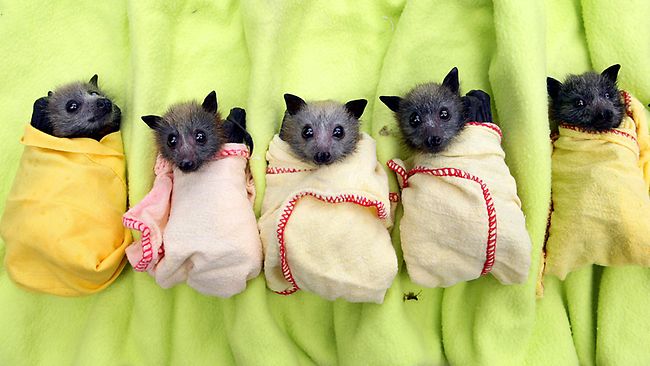
Going into Bat for Orphans

These guys are too cute, wrapped up in their bunny rugs, hehehe :)


Reposted in full from
Adelaide Now/Sunday Mail, 9 January 2011

'Torrential rain has brought chaos to parts of Australia, and not just to the humans who live there.

Australian Bat Clinic and Wildlife Trauma Centre director Trish Wimberley and her carers have helped save 130 orphaned bats on the Gold Coast in past weeks. They saved 350 young bats during the 2008 storm season but this year think there's more going on than just wild weather.

Carers have visited several bat "camps" on the coast in recent weeks to find four-week-old babies on the ground covered in maggots and fly eggs. Trish said: "They're coming down to feed on the ground. That makes them vulnerable. It's not a natural occurrence and shows there is trouble in the environment. Bats are a barometer to what is going on in the environment. They're our canaries down the coal mine."

The babies will be bottle fed and kept hanging on clothes lines or in intensive care units until they are ready to fly again in about four weeks.'

Inside Job

Love the billing: 'The film that cost $20,000,000,000,000 to make'. Narrated by Matt Damon.

Make sure you see this film...really.

Sourced from Sony Pictures, 2010

10 January 2011

Is It Food?

Sourced from The Huffington Post, 7 January 2011

click to enlarge

09 January 2011

The Changemakers' Toolbox

Sourced from New Organizing Institute

Campaign Strategy

Not the best videoing, which is a shame, because the content is good...

Sourced from YouTube, 15 May 2007

Chris Rose of Campaign Strategy provides a brief introduction to effective campaigning as outlined in his book.

Part 1 (10 mins)


Part 2 (10 mins)


Part 3 (3 mins)

07 January 2011

The Tyranny of Entitlement - Derrick Jensen

Reposted in full from Orion Magazine, January 2011

'I’m continually stunned by how many seemingly sane people believe you can have infinite economic growth on a finite planet. Perpetual economic growth and its cousin, limitless technological expansion, are beliefs so deeply held by so many in this culture that they often go entirely unquestioned. Even more disturbing is the fact that these beliefs are somehow seen as the ultimate definition of what it is to be human: perpetual economic growth and limitless technological expansion are what we do.

Some of those who believe in perpetual growth are out-and-out nut jobs, like the economist and former White House advisor Julian Simon, who said, “We have in our hands now - actually in our libraries - the technology to feed, clothe, and supply energy to an ever-growing population for the next 7 billion years.” And showing that, when it comes to U.S. economic policies, insanity is never out of season, are yet more nut jobs, like Lawrence Summers, who has served as chief economist at the World Bank, U.S. secretary of the treasury, president of Harvard, and as President Obama’s director of the National Economic Council, and who said, “There are no...limits to the carrying capacity of the earth that are likely to bind at any time in the foreseeable future...The idea that we should put limits on growth because of some natural limit is a profound error.”

Others are a bit more nuanced in their nut-jobbery. They may acknowledge that, yes, physical limits might possibly exist, but they also believe that if you just slap the word sustainable in front of the phrase “economic growth,” then you can still somehow have continued growth on a finite planet, perhaps through so-called “soft” or “service” or “high-tech” economies, or through nifty “green” innovations like a really neat nanotech gizmo that can be woven into your clothes and when you dance it generates enough electricity to power your iPod, ignoring the facts that people still need to eat, that humans have overshot carrying capacity and are systematically destroying the natural world, and that even something as groovy as an iPod requires mining, industrial, and energy infrastructures, all of which are functionally unsustainable.

Alongside the nut jobs, there are an awful lot of people who probably just don’t think about it: they simply absorb the perspective of the newscasters who say, “Economic growth, good; economic stagnation, bad.” And of course if you care more about the economic system than life on the planet, this is true. If, however, you care more about life than the economic system, it is not quite so true, because this economic system must constantly increase production to grow, and what, after all, is production? It is the conversion of the living to the dead, the conversion of living forests into two-by-fours, living rivers into stagnant pools for generating hydroelectricity, living fish into fish sticks, and ultimately all of these into money. And what, then, is gross national product? It is a measure of this conversion of the living to the dead. The more quickly the living world is converted into dead products, the higher the GNP. These simple equations are complicated by the fact that when GNP goes down, people often lose jobs. No wonder the world is getting killed.

Once a people have committed (or enslaved) themselves to a growth economy, they’ve pretty much committed themselves to a perpetual war economy, because in order to maintain this growth, they will have to continue to colonize an ever-wider swath of the planet and exploit its inhabitants. I’m sure you can see the problem this presents on a finite planet. But in the short run, there is good news for those committed to a growth economy (and bad news for everyone else), which is that by converting your landbase into weapons (for example, cutting down trees to build warships), you gain a short-term competitive advantage over those peoples who live sustainably, and you can steal their land and overuse it to fuel your perpetual-growth economy. As for those whose land you’ve stolen, well, you can either massacre these newly conquered peoples, enslave them, or (most often forcibly) assimilate them into your growth economy. Usually it’s some combination of all three. The massacre of the bison, to present just one example, was necessary to destroy the Plains Indians’ traditional way of life and force them to at least somewhat assimilate (and become dependent upon the growth economy instead of the land for their very lives). The bad news for those committed to a growth economy is that it’s essentially a dead-end street: once you’ve overshot your home’s carrying capacity, you have only two choices: keep living beyond the means of the planet until your culture collapses; or proactively elect to give up the benefits you gained from the conquest in order to save your culture.

A perpetual-growth economy is not only insane (and impossible), it is also by its very essence abusive, by which I mean that it’s based on the same conceit as more personal forms of abuse. It is, in fact, the macroeconomic enshrinement of abusive behavior. The guiding principle of abusive behavior is that the abuser refuses to respect or abide by limits or boundaries put up by the victim. As Lundy Bancroft, former codirector of Emerge, the nation’s first therapeutic program for abusive men, writes, “Entitlement is the abuser’s belief that he has a special status and that it provides him with exclusive rights and privileges that do not apply to his partner. The attitudes that drive abuse can largely be summarized by this one word.”

The relevance of this word applies on the larger social scale. Of course humans are a special species to whom a wise and omnipotent God has granted the exclusive rights and privileges of dominion over this planet that is here for us to use. And of course even if you subscribe to the religion of Science instead of Christianity, humans possess special intelligence and abilities that grant us exclusive rights and privileges to work our will on the world that is still here for us to use. Growth economies are essentially unchecked and will push past any boundaries set up by anyone other than the perpetrators: certainly the fact that indigenous cultures already are living on this or that piece of ground has never stopped those in power from expanding their economy; nor is the death of the oceans stopping their exploitation; nor is the heating of the planet stopping the exploitation; nor is the grinding poverty of the dispossessed.

And the truth is, you cannot talk abusers out of their behavior. Perpetrators of domestic violence are among the most intractable of all who commit violence, so intractable, in fact, that in 2000 the United Kingdom removed funding for therapy sessions designed to treat men guilty of domestic violence (putting the money instead into shelters and other means of keeping women safe from their attackers). Lundy Bancroft also says this: “An abuser doesn’t change because he feels guilty or gets sober or finds God. He doesn’t change after seeing the fear in his children’s eyes or feeling them drift away from him. It doesn’t suddenly dawn on him that his partner deserves better treatment. Because of his self-focus, combined with the many rewards he gets from controlling you, an abuser changes only when he feels he has to, so the most important element in creating a context for change in an abuser is placing him in a situation where he has no other choice.”

How do we stop the abusers who perpetrate a perpetual-growth economy? Seeing oiled pelicans and burned sea turtles won’t move them to stop. Nor will hundred-degree days in Moscow. We can’t stop them by making them feel guilty. We can’t stop them by appealing to them to do the right thing. The only way to stop them is to make it so they have no other choice.'

06 January 2011

The Naked Presenter


Anyone who uses (or who has been subjected to BAD Powerpoint presentations, anyone? Anyone?) will love this! 'If Darth Vader did a Powerpoint it would look like this...' LAUGH!!

Sourced from Presentation Zen, 4 January 2011

http://vimeo.com/14493347

Credit Card Exorcisms

Credit card exorcisms!! But maybe they are necessary - according to this report, the US now has more shopping malls than high schools...

Sourced from YouTube, 30 December 2010

04 January 2011

Equality and The Good Life

Excerpt from YES! Magazine, 4 March, 2010

'For decades, (British Epidemiologist) Richard Wilkinson has studied why some societies are healthier than others. He found that what the healthiest societies have in common is not that they have more—more income, more education, or more wealth—but that what they have is more equitably shared.

In fact, it turns out that not only disease, but a whole host of social problems ranging from mental illness to drug use are worse in unequal societies. In his latest book, The Spirit Level: Why More Equal Societies Almost Always Do Better, co-written with Kate Pickett, Wilkinson details the pernicious effects that inequality has on societies: eroding trust, increasing anxiety and illness, encouraging excessive consumption...

Wilkinson: 'We quote a prison psychiatrist who spent 25 years talking to really violent men, and he says he has yet to see an act of violence which was not caused by people feeling disrespected, humiliated, or like they've lost face. Those are the triggers to violence, and they're more intense in more unequal societies, where status competition is intensified and we're more sensitive about social judgments...

This is about the psychosocial effects of inequality—the impact of living with anxiety about our feelings of superiority or inferiority. It's not the inferior housing that gives you heart disease, it's the stress, the hopelessness, the anxiety, the depression you feel around that...

What we've learned is that the real quality of life for all of us now depends on improving the social environment, and that we have a policy handle on how to do that. It's not that we all need to have more therapy to try and make us nicer people. Income distribution, an issue government or big corporations can do something about, really affects the psychosocial well-being of the whole society. But we can't just rely just on taxes and benefits to increase equality—the next government can undo them all at a stroke. We've got to get this structure of equality much more deeply embedded in our society. I think that means more economic democracy, or workplace democracy, of every kind. We're talking about friendly societies, mutual societies, employee ownership, employee representatives on the board, cooperatives—ways in which business is subjected to democratic influence. The bonus culture was only possible because the people at the top are not answerable to the employees at all...''

Paint, Power & the World We Want


Reposted in full from
YES! Magazine, 12 May 2010

'“That’s public space. Nobody can use it.”

That was one Portland city official’s response when Mark Lakeman and his neighbors first began building unauthorized gathering places in their neighborhood in 1996.

To Lakeman, an urban designer, this seemed like a fundamental misunderstanding of public space. Together with his neighbors, he formed the City Repair Project, a volunteer-run nonprofit that set out to change the way Portlanders think about the places where people come together.

They started by reclaiming their own intersection, and were eventually organizing neighbors, building benches, and painting streets throughout the city. The goal, as City Repair’s motto puts it, was no longer just to preserve public space, but, by recognizing its character and identity, to transform it into Place: “inhabited, known, and loved by its residents.”

At the end of this month, City Repair will host its eighth annual building convergence, a ten-day festival hosting workshops and neighborhood improvement projects around the city. City Repair’s projects now include Depave Portland, which removes unnecessary asphalt to make way for urban gardens, and Upcycle Market, a monthly event where people get together to swap skills and supplies. Groups around the country are trying out City Repair's methods in their own neighborhoods.

And Portland itself? The city now sees public space—and neighborhood building projects—quite differently. Not long after City Repair was founded, the city passed an ordinance allowing neighborhoods to build gathering places in street intersections.

Brooke Jarvis: You called your organization City Repair—in what way are cities broken?

Mark Lakeman: For most of the history of humanity, we lived and worked in the same places, integrated, and everything we did would deepen our relationships to each other. The greatest product of that way of life was our cultural cohesion and our stories—we weren’t isolated the way that we are now.

But our cities and places are no longer ours. We’re not building our own places; we’re not designing them to fit our own needs. Our lives are zoned like we’re a resource to be managed. We're housed here, and then this is where we work in order to pay for the housing we barely get to live in. Mixed use here. Monocultural use here. Parking garage. Maybe a waterfront here. Park. Park. It doesn't add up. None of them are really whole.

So many of our phobias and issues come from separating the pieces of our lives. We’re less connected to the people around us, and we’re less connected to our work: the fruit of our labor goes into a landfill so that someone can buy a boat. It's the stupidest possible vision, and it plays out in terms of the holocaust of our creativity and of our experience of being alive. It's unfathomable how inefficient it is, and how painful.

Putting the public space back where it's supposed to be may not sound like a huge change, but it has a profound effect on the social culture.

I studied design, and for a while I was working on these big corporate design projects. They were very typical—in the cultural atmosphere they created, in the way they would impact the people that would work there. They weren’t inspiring or creative; they didn’t let people come together; they didn’t encourage people to do the work that would make them happy and make their communities better. I wanted to live in a world that was an expression of who we are.

Brooke: You started with a place that most of us don’t really think of as a place at all: the intersection of two streets. Why not change the places people spend time, like homes, parks, or offices?

Mark: Exactly. Why don’t we spend time in intersections? When I discovered I didn’t want to work on those typical design projects, I decided to look for something else: different patterns, a different perspective on what was possible. While I was traveling, I saw, over and over, that people's gathering places occur where their pathways come together and intersect. The idea of the crossroads is really ancient, of course; it pervades indigenous societies. It’s also a fundamental principle of urban design in modern societies, except it’s often obscured and denied. You're trying to control modern people, to keep them moving, not to let them gather like they would in a village.

When I came back from all these village-based cultures, I walked into the neighborhood where I grew up—a Roman-grid neighborhood, very typical in America, with straight, imposed lines but no gathering spaces—and I'm like, "The piazza is not here, where it's supposed to be."

In America, our great archetype is the main street, which is not really a center. It's just a flow. It's a movement corridor, and you have to yell across the street because there isn't a place in the middle. There isn't a social commons that you can attain and occupy.

10 Courageous Things You Can Do to Build Community

Putting the public space back where it's supposed to be may not sound like a huge change, but it has a profound effect on the social culture. Everybody needs it even though they don't know it's missing. I knew that from visiting other societies where it was present, where there is cohesion and vitality and integrated families and community structures. We know that Americans are more lonely and isolated than ever before, but we don’t realize that the absence of cohesion in American communities is totally related to the absence of places where people can actually build that.

Brooke: But if you can’t redesign the whole neighborhood, what do you do to change an intersection built for cars into a place where people can build community?

Mark: At our first project, the neighbors who lived around the intersection came out on the weekend, painted a design in the street, built all these structures around the corners—a bench, a lending library, a 24-hour tea stand, a children’s playhouse, a kiosk for sharing neighborhood information—and turned it into an interactive social space. And boom!

That was years ago. Share-It Square—that’s what we call it—is one of my favorite projects because I live right there, I get to see its evolution. Since then people have built saunas, put in gardens, helped each other paint their houses. Americans move every four to seven years, and that period of time is visibly lengthening right around that intersection because people want to live there. Families are clustering around it, having kids or bringing their kids, so there are more children—and more shared childcare, and more adults interacting with kids on the street.

Sometimes people living there disagree about what they want to do, and they wonder if that's imperfect. I think it's beautiful. People are learning about each other, and working things out. Sometimes it's a bunch of steps forward and a few steps back, and every step back is OK. It's like you're just setting foot a little bit more solidly before you take another step forward. It's wonderful.

Brooke: Did the city, and other authorities, feel the same way?

Mark: At first, everybody was telling us that we had broken the law, but once they saw what we’d actually done, they wanted to figure out how to do it again. The mayor saw it, and she's like, "You need to tell me what you've done, because I can see that it's good, but I don't understand.” The city had established all of these goals for livability and sustainability and walkability and safer streets and safer kids, but getting there was another story. You can't achieve those goals unless you do what we did. All the solutions to all those goals can only be generated by people right where they live, finally having power together.

The power of what we do is we start with the idea and the belief that we can make it happen.

There’s so much we need to change, but I really don’t think it's going to be all that hard. We just need to say, "There's nowhere to sit around here? Well, we need to create some places to sit. People aren't talking? Then we need gathering places." You look at the problem of a particular place and you address it. People start to get excited; the void starts to get filled. The projects are small, but they keep coming as revelations.

Brooke: So what did you say to the mayor? What had you done that was different from what the city did, trying to accomplish the same goals?

Mark: The city has a different method. People generate goals for their neighborhoods, which go into reports and onto shelves. And they sit there long enough that people forget about them. But the needs are still unmet, so they fundraise and they meet and they generate new goals—and those go into a report on another shelf.

The power of what we do is we start with the idea and the belief that we can make it happen. If it has a social basis, if your primary goal is to build networks and relationships, then you attract all the other forms of capital that begin with the social. That's the magic. That's the key.

After everything you see on TV or in politics, you would think that asking a group of Americans to sit down and work out something like this would be difficult. But it's not. People sit down for a potluck, and maybe that very evening they start talking about what they want to do. This year, we're going to reach a total of over 200 major sites and almost 300 little projects that have been built.

Brooke: Do you have any favorites, among the projects you’ve worked with?

Mark: Some of them are really simple things. Like, there's this wonderful intersection that has a painting of an oak tree, in honor of a tree that used to stand there. Everyone called it Ruth’s tree after their neighbor, who had planted it when she was a little girl. When she was in her 90s, she died. Shortly after, the tree fell over into the intersection. So the community comes out and paints this huge effigy of the tree, right there.

Then there’s the T-Horse, which is a mobile tea house—it travels around to different neighborhoods in Portland, and wherever it goes people gather to drink tea, or play Frisbee, or whatever. It’s a vehicle with enormous wings, so it really entices people out.

The Memorial Lighthouse is also beautiful. It's a solar-powered pillar of cob that glows at night, decorated with bicycle wheels and mosaic stained glass. It was built in memorial to a bicyclist who was killed there, by a truck. His mother and friends would bring flowers and gifts and leave them in the place where he died, and his mother would come and mourn him, just sitting there on the sidewalk. Finally the neighbors asked if one of the corners of the intersection—a corner of a person's yard—could be turned into a memorial to him and a place for his mother to sit. So this beautiful celebration of his life was created. He was a bicycle activist, so there's a strong bike theme.

And every one of them is as dear as that. When that one was built, a lot of us realized that up to that point there had not been one public memorial to any of the people we lived with in our community—they were all to dead presidents or wealthy people. So that one project not only turned a tragedy into a permanent celebration of someone’s life, it helped uncover all of these issues about inequity and political power. I don't know of one project that hasn't done that.

Brooke: As neighborhoods come up with their own projects, what is City Repair’s role?

Mark: It’s really upending the model I was taught—to be the author of someone else's project, the designer. What we do now is take calls for help. These days we convene dozens of neighborhoods at once—there are maybe three dozen projects happening around Portland right now. Our main role is facilitation, taking people through dialogues about fundraising or outreach or ecological design, teaching skills that communities can use on their own.

The focus that we have them constantly keeping in mind is that they're not building stuff. They're building relationships. How they treat each other is the most important thing, and what it looks like doesn't matter at all.

Brooke: It seems kind of telling that even when people recognize what’s missing and have great ideas about ways to fix it, we still feel powerless enough that we reach out to groups like City Repair for help. Why do you think we need that catalyst?

Mark: I think it’s a confidence issue. We hear so often in the media that we’re inadequate: Americans only have 15-second attention spans, or are more polarized than ever, or this is how often we hurt or kill each other. We see this as portraits of who we are and we believe that we’re not capable of working together. After what we’ve done with City Repair, I totally know that it can be very different.

But it’s not surprising that some people need a little bit of help to confirm their suspicions that we're good, or that we can be. Just to feel good about being human needs a little confirmation.

The same is true for our sense of our own power. It's always felt so absurd to read in the paper, "Here's something wrong, here's something wrong, here's something wrong"—and know we all feel helpless to do anything about it because we have to get back to work. That's the work. Every American neighborhood is characterized by this absurdity: There are children being victimized or there's domestic violence, but at the beginning of the day we get ourselves all ready and we go off to do something that we often don't even respect or enjoy. And at the end of the day we haven't addressed these bleeding concerns in our communities.

When did we stop believing we had a say in our own reality? What if someone asked you at the start of your life, "Where will your power reside? Will it be in you or someone else?" Given that choice, everyone would say, “Me.” And what would you do with that power? "Wow, I would help the world," is what a whole lot of people would say. If that were how we answered that fundamental question, our world would be so different. The beautiful thing happening now is that dozens and dozens and dozens of people saying, "Yes, I have my power," and then creating these physical expressions of what it actually looks like.'